
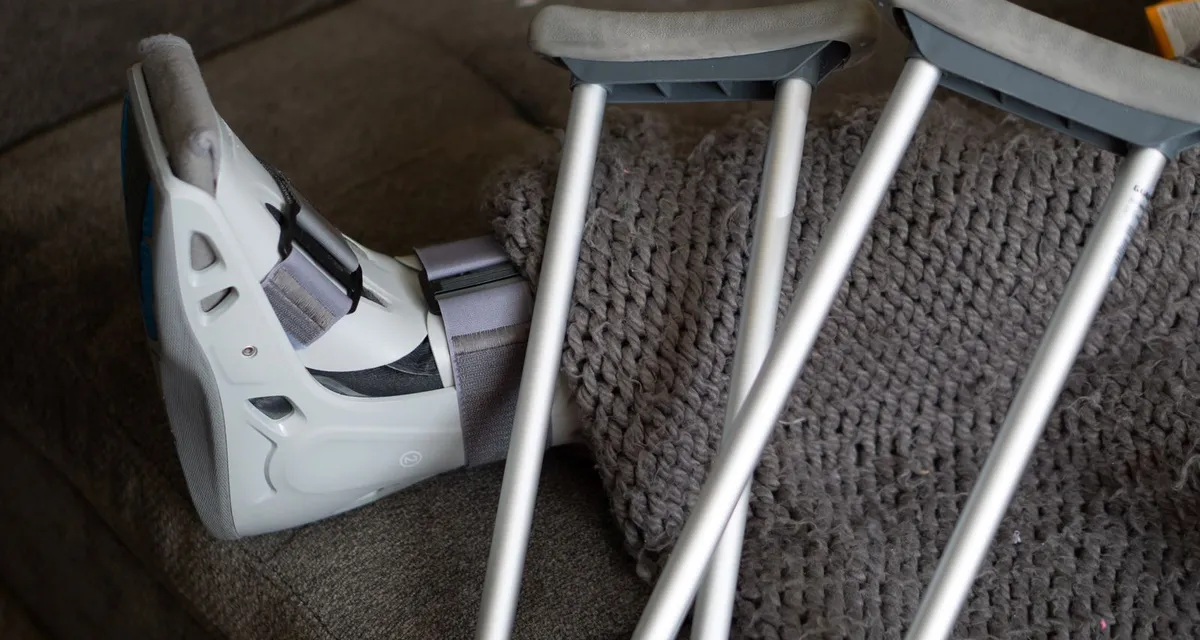
This is the most common serious injury we see from the ski corridors and the resort corridors alike, and it produces the widest gap between what patients expect and what actually happens. A broken leg feels like a problem of pain and inconvenience. For a flight it is a problem of pressure, space and clots.
The cast, and why airlines care
Plaster is rigid. A limb that swells inside it has nowhere to go, and the result is pressure on the tissue underneath rather than a visibly swollen leg.
Cabin pressure falls in cruise, to the equivalent of roughly 6,000 to 8,000 feet. Swelling that would have been tolerable at sea level is less so at altitude, and a recently injured, recently plastered limb is at its most swollen in the first day or two.
Hence the rule that most carriers apply: a cast applied within roughly 24 to 48 hours of the flight should be split along its length before travel, so there is room to expand. It takes minutes at the treating hospital and it is close to impossible to arrange at an airport. Airline requirements differ in the detail, so the specific rule is worth confirming when the flight is booked rather than assumed from a general recollection.
What the injury itself dictates
The cast is the visible issue. Three clinical ones sit behind it.
Fat embolism, after a long bone fracture, typically declares itself in the first couple of days. It is uncommon and it is serious, and it is a strong argument against flying a fresh femoral or tibial shaft fracture on the first available seat.
Clot risk. An immobilised lower limb is a recognised risk factor for venous thromboembolism on its own. Add a long sector in a seat and the exposure compounds. This is one of the conditions where the length of the flight changes the clinical decision rather than merely the comfort, and the prophylaxis plan should be explicit and written down.
Whether the fracture is definitively managed. A patient who needs fixation is better fixed before a long journey than after it, unless the local capability is the reason for moving. That is a judgement about the receiving pathway rather than the injury, and it is the same question set out on the corridor pages: does the ongoing treatment need to be at home, or can it be completed well where they are?
The part nobody plans for
A leg that will not bend does not fit an economy seat.
That sentence causes more disrupted travel plans than any of the physiology above. A knee held in extension needs room, and the practical options are extra seats booked as a medical arrangement, a bulkhead or premium cabin with more pitch, or a commercial stretcher.
Two consequences follow. The first is that this has to be arranged in advance with the airline, because it cannot be improvised at the gate. The second is commercial: once several seats are being bought, the gap between a seated arrangement and a stretcher narrows considerably, and the honest comparison is the one made in what a medical repatriation actually costs rather than an assumption that commercial is always cheaper.
There is also the question airlines ask and families do not expect. Can the passenger evacuate the aircraft unaided in an emergency? A patient on crutches with a leg in plaster generally cannot, which rules out exit rows and may require somebody travelling with them.
What this means if you are managing a case
Orthopaedic cases are the ones most often waved through, because a broken leg is not frightening in the way a head injury is. They are also the ones that produce the most avoidable disruption.
Four things sort them out early. Establish when the cast was applied and whether it has been split. Get the treating team’s view on fat embolism risk and on thromboprophylaxis, in writing. Establish whether the leg can bend, because that single fact determines the transport arrangement and the cost. And book the airline’s medical arrangements as soon as the plan is clear, since seats, stretchers and clearances all have lead times that a discharge date does not respect.
The general framework is in medical repatriation and patient transport. On a fractured limb the specific discipline is to treat the logistics as clinical, because with this injury they are.