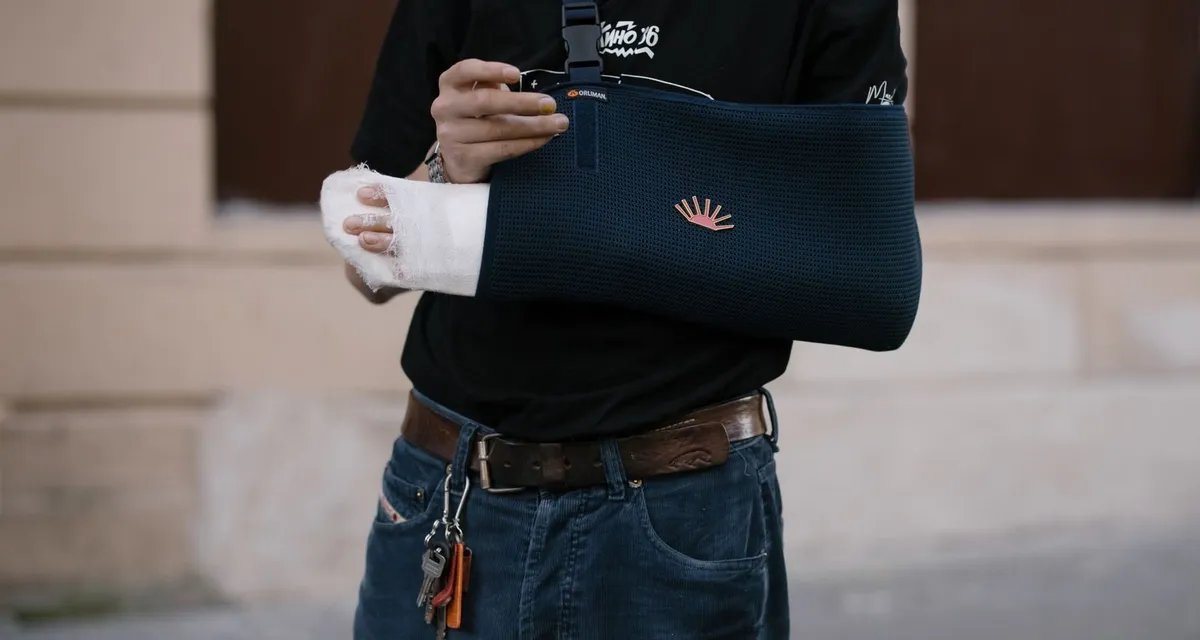
Most people who ask this have a forearm in plaster and a flight booked before their fracture clinic appointment. The answer is usually yes, with conditions that depend mostly on how recently the cast went on.
A cast on the leg is a bigger question, and it has its own article. This one is mostly about arms and wrists.
Why a fresh cast is the issue
A broken bone swells, and the swelling is usually at its worst in the first day or two. Plaster and fibreglass are rigid. If the limb swells inside a closed cast, the pressure has nowhere to go except into the tissue underneath.
In flight the cabin is pressurised to the equivalent of roughly 6,000 to 8,000 feet, and that cabin altitude makes swelling in a recently injured limb harder to tolerate than it would be on the ground. Sitting still with the arm hanging down for several hours does not help.
That is why many airlines have a rule for recent casts. A commonly applied version is that a full cast fitted within roughly 24 to 48 hours of the flight should be split along its length before travel, so it can open slightly as the limb swells. Some airlines ask passengers to wait instead, and some ask for airline medical clearance for a recent cast. The detail differs, so it is worth checking the airline’s own rule when booking.
Many fractures treated abroad start in a backslab, a half cast held on with a bandage, precisely because it allows for swelling. The full cast often goes on later at the fracture clinic. A backslab is usually less of a concern for flying than a fresh full cast, though the same airline rules may still apply.
A broken arm or broken wrist
A broken wrist is the fracture people most often fly home with. It does not need extra legroom, and most people with one can sit normally in an ordinary seat. The practical problems are smaller ones, and they add up on a long travel day.
Swelling. Keep the hand raised where you can, and keep moving the fingers. A sling helps on the walk through the airport.
Managing one-handed. Lifting a bag into an overhead locker, carrying a tray and opening packets all become harder. Ask the airline for assistance when booking rather than relying on goodwill on the day.
The seat. A seat where the injured arm faces the window rather than the aisle keeps it away from trolleys and passing elbows. Exit rows are not available, because a passenger there has to be able to help in an evacuation.
Paperwork. A short letter from the hospital describing the injury and the cast helps at security, where a cast may need extra screening. Bring the x-ray images and the discharge summary home as well. The fracture clinic will want them, and they are much harder to obtain once you have left.
Upper arm and collarbone fractures are often treated in a sling rather than a cast. The split cast rule then does not apply, though pain control and managing alone still do. If the fracture was fixed with an operation, the surgeon is the person to ask about timing, because the decision then includes the operation and the anaesthetic as well as the bone.
Whatever the fracture, some signs mean the cast needs checking before you fly: fingers that are numb, tingling, pale, blue or very swollen, pain that is getting worse rather than better, or a cast that feels tighter. If they appear during the flight, raise the arm, move the fingers and tell the crew, then get it checked on arrival.
A cast on the leg
A leg in plaster is a different proposition. A knee that will not bend does not fit an economy seat, an immobilised leg raises the risk of a clot on a long flight, and a passenger on crutches may not be able to leave the aircraft unaided in an emergency. A significant fracture can mean extra seats or a commercial stretcher.
All of that is covered in can you fly with a broken leg?, including what the injury itself dictates and the questions airlines ask.
What this means if you are managing a case
An arm or wrist fracture on its own rarely needs a medical repatriation. Most patients can fly home on a scheduled seat once the cast is safe and the pain is controlled.
The cases worth a second look are the ones where the fracture is a clue to something else. An older traveller who has broken a wrist in a fall should prompt the question of why they fell, because a faint, a heart rhythm problem or a new medication can matter more than the fracture. The other is the fracture that needs an operation, where the real decision is whether to fix it locally or at home, and that depends on the local capability and the receiving pathway.
Both are clinical questions, and they need a named clinician to answer them before a flight is booked. That is the discipline described in medical repatriation and patient transport, and the reasoning about matching transport to the patient is in what good repatriation actually looks like.