

Medical repatriation from Canada
Almost every British visitor assumes Canada works like the NHS. It does not work like that for them. There is no reciprocal agreement, visitors are billed, and the daily rates sit closer to the United States than to Europe.
7 to 8 hours from the east coast, 9 to 10 from Vancouver and the west
No reciprocal arrangement with the UK. Provincial health plans cover residents, not visitors, who are billed directly and at rates closer to the American market than the European one
What we typically see from Canada
- Ski and snowboard trauma in the Rockies and the eastern resorts, weighted towards knee, shoulder and head injury
- Cardiac events and strokes in older visitors, including a large visiting friends and relatives population
- Road trauma on long rural drives and on motorhome and touring holidays
- Wilderness and backcountry injury, where the retrieval leg is by air and the nearest hospital is regional rather than tertiary
- Cold injury and exposure in winter, and heat and wildfire smoke related presentations in the western summer
- Deterioration of chronic disease in long-stay winter visitors and in patients staying with family
The assumption that costs the most
Ask a British traveller what happens if they are taken ill in Canada and most will say something reassuring about a public health system much like ours. They are describing a system that exists and that they are not part of.
Provincial health plans cover provincial residents. A visitor is a private patient, invoiced directly, at rates that sit much closer to the American market than the European one. There is no reciprocal agreement of the kind that exists with Australia, and no card that helps.
The practical consequence is that a Canadian case behaves commercially like a United States case while feeling to everybody involved like a European one. That mismatch is where the money goes. An admission nobody is managing, on the assumption that it is broadly covered, accrues at a rate that surprises people three weeks later.
The response is the one we argue everywhere and it matters as much here as in Florida: issue the guarantee of payment fast so the case keeps moving, and issue it scoped so nobody has committed to a pathway they have not seen. The reasoning is in who actually pays, and when, and the billing disciplines are the same ones set out on the United States corridor.
Winter, and the distance behind the resort
A large share of British cases in Canada come off a piste, and the resorts are further from definitive care than their infrastructure suggests.
Resort clinics deal well with the immediate injury. What follows is the problem: definitive care for anything serious is in Calgary or Vancouver, and reaching it may mean a long road transfer in winter conditions or an air leg. By the time the patient is in a tertiary centre, the Atlantic crossing is the shortest and simplest part of the whole journey.
Two consequences. The timeline has to be built bed to bed rather than from a departure slot, because the ground and domestic legs dominate it. And head injury deserves the slower answer, as it does in every mountain corridor: a patient who is neurologically well on the ward may still be some way from being fit for the cabin altitude of a commercial flight, and that interval is a clinical judgement rather than a scheduling one.
Where the domestic leg is the real journey
Canada is very large, and a meaningful share of cases begin somewhere that is not near anything.
A patient injured in the backcountry, in the north, or on a touring holiday between cities may be a long air leg from a hospital that can treat them properly, and that leg can exceed the Atlantic crossing in both hours and complexity. It carries its own cost, its own clinical handover and its own weather constraints.
Treat such a case as two journeys. The second cannot be planned until the first has landed, and a plan that reads the case as a single flight home will come apart at the first domestic connection.
The transport picture
Seven to eight hours from Toronto or Montreal, nine to ten from Vancouver, with the shortest crossing of all from Halifax.
For a stable patient a commercial stretcher or a seated medical escort is both clinically appropriate and substantially cheaper than a dedicated aircraft. Sector length still changes the assessment: oxygen planned across a full duty period, prolonged immobility, infusions managed throughout, and an escort who has to remain effective the whole way.
A dedicated air ambulance earns its place for the ventilated or unstable patient, and occasionally where a difficult domestic leg can be collapsed into a single flight rather than a road transfer followed by a scheduled departure. That is a decision about the whole journey rather than about the Atlantic.
Before the patient moves
Fitness to travel is assessed against the patient’s actual trajectory by a UK clinician who is accountable for it, and revisited if the picture changes. The UK receiving bed is secured before departure, matched to the consultant and the pathway rather than to the arrival airport. The clinical record reaches the receiving team ahead of the patient, and ground transfers at both ends are arranged and briefed.
Every decision is recorded in Atlas as it is made. For the general picture see medical repatriation and patient transport, and for the mountain corridor with the same retrieval problem and a much shorter flight, medical repatriation from Switzerland.
Where we stage from
The airport a case leaves from is a clinical decision as much as a logistical one, and it is set by where the patient is and what they can tolerate on the ground.
- Toronto (YYZ): the widest scheduled and stretcher capacity, and the shortest sector to the UK
- Vancouver (YVR): the west coast and the British Columbia resorts, on a notably longer sector
- Calgary (YYC): the gateway for the Rockies, and the usual staging point for a Banff or Lake Louise case
- Montreal (YUL) and Halifax (YHZ): the east, with Halifax the shortest Atlantic crossing of all
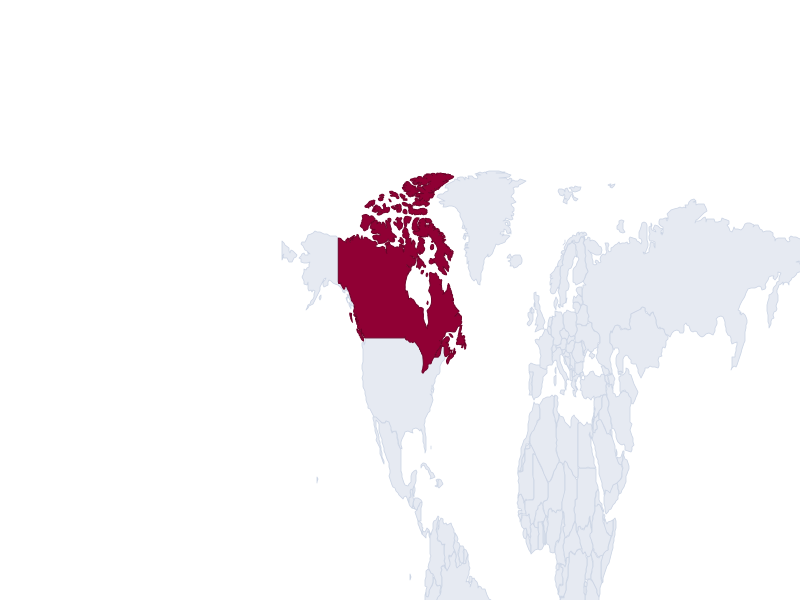
What a repatriation from Canada costs
Canada prices in the Medium haul, 5 to 8 hours band. The range alongside is bed to bed and all in, covering the ground ambulance at both ends, the UK receiving bed and clinical handover, crew, equipment and oxygen, the seat block or stretcher, handling, landing and permits, the escort return travel and case management. Nothing here is a flight price with extras to follow.
£5,000to£30,000
From a medical escort in an economy seat to an air ambulance, bed to bed and all in.
The east coast prices in this band. Vancouver and the west sit at 9 to 10 hours and price as long haul.
Figures as at August 2026, from a blend of actual UCS Assist cases and supplier ranges. Ranges are wide because cases are not alike. The full bed-to-bed cost breakdown prices each mode of transport, sets out what moves a case up its band and shows how to sense-check a quote.
Common questions
Is there really no reciprocal healthcare agreement with Canada?
There is not, and it is the single most common misunderstanding on this corridor. British visitors reasonably assume that a country with a public health system funded much as ours is will treat them on the same basis. Provincial health plans cover provincial residents. A visitor is a private patient, billed directly, at rates that sit much closer to the American market than to the European one. A case that goes unmanaged here gets expensive at a pace people associate with the United States.
What does that mean for the guarantee of payment?
It has to go out early and it has to be scoped. Early because a hospital with an unconfirmed payer will not move the case along, and every day of an unmanaged admission is costly. Scoped because an open ended commitment in a market that bills by the item, at these rates, is exactly the exposure that clinical bill review exists to prevent. The same disciplines that apply to the United States apply here, and for the same reasons.
What is different about a ski case in the Rockies?
Distance. Resort clinics handle the immediate injury well, but definitive care is in Calgary or Vancouver, and the transfer to reach it can be a long road or air leg in winter conditions. The international flight is then the last and easiest part of the journey. Build the timeline bed to bed rather than around a departure slot, and treat head injury with particular care, because the interval between neurologically well on a ward and fit for cabin altitude is a genuine clinical distance rather than a formality.
How long is the domestic leg likely to be?
On a wilderness or northern case it can be longer than the Atlantic crossing, and it will often be by air because there is no realistic road alternative. That leg is a separate event with its own cost, its own clinical handover and its own weather constraints, and the international planning starts after it rather than instead of it. Reading a Canadian case as a single flight home is how a plan comes apart.
Should we repatriate, given the standard of care?
Canadian hospitals are excellent, so the argument for moving a patient is almost never about the quality of treatment. It is about the pathway: rehabilitation over weeks, staged surgery, continuity with a UK consultant, or a family picture that cannot be sustained. What does push in the other direction here, unlike Australia, is the cost of a long admission to a private-paying visitor, and that is a legitimate factor as long as it is weighed rather than allowed to decide on its own.
How quickly can a repatriation be arranged?
Once the patient is fit to travel, typically two to three days from the eastern cities and longer from the west or from anywhere requiring a domestic leg. Stretcher space needs booking, an escort has to be positioned, and the receiving bed has to be held for an arrival that follows a long overnight sector.
Other corridors
Managing a case in Canada?
Our clinical and operational teams are available around the clock. If the case is live, call rather than email.