

Medical repatriation from Germany
Germany is the corridor where the clinical case for moving a patient is weakest and the commercial case for watching the bill is strongest. Both facts are routinely missed, and they point in opposite directions.
1.5 to 2 hours from Frankfurt, Dusseldorf or Berlin, and a viable road and tunnel option from the west
A UK GHIC gives access to the statutory system on the same terms as an insured resident. It has no standing in private treatment, where a separate fee schedule and multiplier apply
What we typically see from Germany
- Cardiac events and strokes in business travellers, a working-age case mix unlike the resort corridors
- Autobahn and road trauma, including high-energy injury reaching a major trauma centre quickly
- Winter sports injury in the Bavarian Alps and the Black Forest, at lower volume than Austria or Switzerland
- Deterioration of chronic disease in visiting family, particularly in the large UK-German community
- Cases already transferred into Germany from elsewhere in Europe for specialist care, where the UK leg is the second move
- Occupational injury on industrial and construction contracts, where the employer rather than an insurer is the payer
The corridor where moving the patient is usually the wrong instinct
Germany produces a particular kind of case. The patient is more likely to be working than holidaying, more likely to be of working age, and much more likely to be in an excellent hospital receiving exactly the right treatment.
That last fact should govern the decision and frequently does not. There is an instinct in assistance to bring a patient home because home feels safer, and on this corridor it is very hard to argue that a German trauma centre or cardiac unit is the weaker option. The honest question is the one we ask everywhere: does the ongoing pathway need to be in the UK?
Where the answer is rehabilitation over weeks, staged surgery, or continuity with a consultant who already knows the patient, repatriation is right. Where the answer is that the case is open and somebody would like it closed, it is not.
Two systems, and the bill only appears in one
Germany runs a statutory health system that a UK GHIC gives genuine access to, and a private sector alongside it. Emergency care generally routes into the statutory system, which is the reason a great many German cases produce no significant exposure at all.
The cases that do produce exposure are the ones where the patient is being treated privately. There the position is entirely different, and it is different in a way that is specific to this country.
German private medical fees are set against a published national schedule, and the treating practitioner may apply a factor above the base rate for each item billed. Used properly the factor reflects genuine complexity in that patient. Used as a blanket setting across an invoice, it multiplies a whole account without any clinical narrative explaining why this case was harder than the schedule assumes.
Nothing about that is improper, and it is not fraud. It is a billing convention that rewards the payer who reads it. Asking whether the factor applied to each item is supported by the record is a technical, collegial question with a defensible answer either way, and it is one of the more productive lines of clinical bill review available anywhere in Europe.
A working-age caseload
The case profile here looks different from the Mediterranean corridors and it is worth planning for.
Business travel produces cardiac events and strokes in people in their forties and fifties, often alone, often with no travelling companion to give a history. The industrial and construction belt around the Rhine and Ruhr produces occupational injury where the payer may be an employer, a project policy or a statutory accident scheme rather than a travel insurer. Road trauma on the autobahn network reaches a major trauma centre fast, which is why survival is good and why the resulting cases are complex ones.
The payer question deserves particular attention. A case with three possible payers, each assuming another is handling it, does not progress. Establishing who is issuing the guarantee of payment on day one is worth more here than almost anywhere, and it is the same discipline set out in who actually pays, and when.
Germany as a destination, not just an origin
Some German cases arrive as the second leg of somebody else’s problem. A patient injured elsewhere in Europe, or in North Africa, is transferred into a German centre for specialist care that was not available locally, and the UK repatriation follows once they are stable.
Those cases need reading as a whole rather than from the point we joined them. What was done at the first facility, what was left, and what the German team is now completing all determine when the patient can safely fly and what the receiving UK team needs to know. Picking up such a case at the German ward round and treating it as the beginning is how a discharge summary arrives in the UK with a fortnight missing from it.
The transport picture
An hour and a half to two hours from the major airports is about as forgiving a sector as exists, with good scheduled capacity including to UK regional airports.
For a stable patient a seated medical escort or a commercial stretcher is both the clinically appropriate answer and the substantially cheaper one. A dedicated air ambulance earns its place for the ventilated or unstable patient.
Germany is also one of the few corridors where road remains genuinely competitive. From the west of the country a road ambulance through the tunnel gives a true bed to bed transfer with no airport, no transfers between vehicles and no cabin altitude, which for some patients is the whole point rather than a compromise. From Bavaria or the east the arithmetic stops working. The same reasoning is set out on the France corridor, where road is the default rather than the alternative.
Before the patient moves
Fitness to travel is assessed against the patient’s actual trajectory by a UK clinician who is accountable for it, and revisited if the picture changes. The UK receiving bed is secured before departure, matched to the consultant and the pathway rather than to the arrival airport. The clinical record reaches the receiving team ahead of the patient, and ground transfers at both ends are arranged and briefed.
Every decision is recorded in Atlas as it is made. For the general picture see medical repatriation and patient transport, and for the corridor with the same standard of care and a very different payment position, medical repatriation from Switzerland.
Where we stage from
The airport a case leaves from is a clinical decision as much as a logistical one, and it is set by where the patient is and what they can tolerate on the ground.
- Frankfurt (FRA): the widest scheduled capacity in the country and the usual answer for a stretcher booking
- Munich (MUC): Bavaria and the Alpine resorts, and strong tertiary capability on the doorstep
- Dusseldorf (DUS) and Cologne (CGN): the Rhine-Ruhr industrial belt, which generates more cases than its visitor numbers suggest
- Berlin (BER) and Hamburg (HAM): the north and east, with fewer stretcher options and a longer lead time
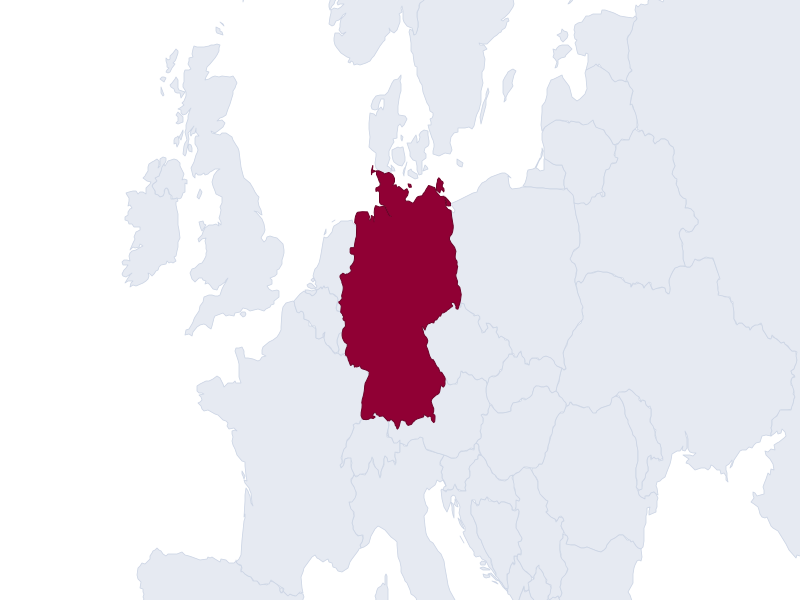
What a repatriation from Germany costs
Germany prices in the Europe, 2 to 4 hours band. The range alongside is bed to bed and all in, covering the ground ambulance at both ends, the UK receiving bed and clinical handover, crew, equipment and oxygen, the seat block or stretcher, handling, landing and permits, the escort return travel and case management. Nothing here is a flight price with extras to follow.
£3,000to£25,000
From a medical escort in an economy seat to an air ambulance, bed to bed and all in.
Figures as at August 2026, from a blend of actual UCS Assist cases and supplier ranges. Ranges are wide because cases are not alike. The full bed-to-bed cost breakdown prices each mode of transport, sets out what moves a case up its band and shows how to sense-check a quote.
Common questions
If German hospitals are excellent, is there any reason to repatriate?
Often not, and this is the corridor where that answer is most defensible. German acute and trauma care is among the best in Europe, and a patient mid-treatment in a German hospital gains nothing clinically from a flight. The reasons that do hold are about the pathway rather than the episode: weeks of rehabilitation that belong near home, staged reconstruction, continuity with a UK consultant, or a family situation that cannot be sustained abroad. Moving a patient for any other reason is a risk taken for a commercial motive.
The patient has a GHIC. Why is there still a bill?
Because the card only reaches the statutory system. If the patient is treated privately, whether by choice, through a private clinic, or as a self-paying foreign patient, they are outside it entirely. German private medical fees are set against a published schedule that permits a multiplier on each item, so the same procedure can be billed at a range rather than a fixed price. That is lawful and routine, and it is exactly the kind of variation that clinical bill review exists to examine.
What is the multiplier and why does it matter to an insurer?
German private billing works from a national schedule of medical fees, where the practitioner may apply a factor above the base rate for the item. Applied properly it reflects genuine difficulty or complexity in a particular case. Applied as a default across an entire invoice it produces a bill several times the base schedule with no clinical narrative to support it. Checking whether the factor is justified item by item is a legitimate technical question and one of the more productive lines of challenge in this market.
How quickly can a repatriation be arranged?
Once the patient is fit to travel, usually within 24 hours from Frankfurt or Munich, and the sector is short enough that scheduled capacity is rarely the constraint. As on every European corridor the timeline is set by clinical stability, obtaining the discharge summary and imaging, and securing an appropriate UK receiving bed rather than by aircraft availability.
Is the road and tunnel route ever the right answer?
From the west of the country it genuinely can be. For a stable patient who is uncomfortable flying, who has a condition where cabin altitude is the specific problem, or who needs a bed to bed transfer with no transfers between vehicles, a road ambulance through the tunnel is a real option. It takes longer in hours and it removes an airport, two ground legs and an aircraft cabin from the plan. From Bavaria or the east it stops making sense.
Who pays when the patient is working in Germany?
Establish this on day one, because it is more often an employer, a project insurer or a statutory accident scheme than a travel policy, and it changes who has standing to make decisions. Occupational cases in the industrial belt are a recognisable share of this corridor, and a case where three parties each assume another is handling the guarantee is a case that stands still while the ward fills the bed.
Other corridors
Managing a case in Germany?
Our clinical and operational teams are available around the clock. If the case is live, call rather than email.