

Medical repatriation from Malta
Malta is easier to work than any other Mediterranean corridor and it has a harder ceiling. Everything is in English and the medicine is familiar, right up to the point where the island cannot offer what the patient needs next.
3 to 3.5 hours from Luqa, with good scheduled capacity in season and noticeably less outside it
A UK GHIC gives access to the state system on the same basis as a Maltese resident, and it works well here. Private clinics sit outside it, and it never covers repatriation
What we typically see from Malta
- Cardiac events and strokes in older British visitors and in the substantial resident retiree population
- Diving injury and decompression illness off Gozo and Comino, requiring recompression before any flight
- Fragility fractures after falls on the islands' steep and uneven streets, a genuinely recurring pattern
- Deterioration of chronic disease in long-stay winter visitors, whose numbers peak when scheduled capacity is thinnest
- Illness and injury in the large summer population of language students, many of them minors travelling without parents
- Road traffic injury, including quad and scooter incidents on Gozo
Familiar medicine, and a hard ceiling above it
Malta is the least friction of any Mediterranean corridor. The clinical culture is closely linked to the UK, a great many doctors have trained or worked in Britain, guidelines and terminology are shared, and every conversation happens in English.
That matters more than convenience. On most corridors a UK clinician assessing fitness to fly is working from a translated discharge summary, an imaging report rather than the images, and a phone call routed through an interpreter, and something is lost at each of those steps. Here the treating consultant can simply be spoken to. Better information produces better decisions, and the decisions on this corridor are correspondingly more reliable.
The limitation is not quality, it is scale. Malta is a small island system with one main hospital carrying the load. It covers the overwhelming majority of what happens to visitors. For a small number of highly specialised pathways it cannot, and the patient has to leave the island for care rather than for home.
Recognising which cases those are, quickly, is the whole skill here. It is also why the transfer decision sometimes has two stages: to capability first, and to the UK afterwards.
The caseload the arrival figures do not show
Three populations generate most of the cases, and only one of them is the obvious tourist.
There is a substantial resident British retiree community, plus long-stay winter visitors, which produces the cardiac events, strokes and fragility fractures typical of an older population a long way from their own GP. Malta’s steep, stepped and uneven streets contribute more falls than a flat resort would.
There is a large summer population of language students, many of them teenagers travelling without their parents. That is a distinctive feature of this corridor and it changes the work: consent, safeguarding, contacting a parent in another country, and a duty of care that has to be discharged carefully rather than administratively.
And there are the divers. Gozo and Comino draw them from across Europe, and decompression illness is a recurrent presentation.
Diving, and the order of operations
Decompression illness is one of the few conditions where the treatment sequence dictates the transport plan entirely rather than the other way around.
Recompression happens locally. The interval before the patient can fly is a clinical judgement, and the reason is precisely the exposure that caused the injury: cabin altitude. On a three hour sector that is not a marginal consideration, and the treating hyperbaric physician’s view needs to be documented in writing rather than inferred from the fact that the patient looks well.
The same discipline applies to any patient with a pneumothorax, recent thoracic surgery or trapped gas anywhere it should not be. See cabin altitude for why the principle is the same in each case.
Gozo starts on a boat
A case on Gozo does not begin at the airport. It begins with a crossing.
Gozo has a hospital for immediate care, but the definitive facilities are on the main island, so a serious case moves by ferry or by helicopter first. Sea state, daylight and the timetable all determine when that can happen, and none of them is negotiable.
Planning such a case from Malta International skips the least predictable leg of the journey. That is the general lesson of the island corridors, the same one that applies to Madeira and to the Greek islands: build the plan from where the patient physically is, not from the nearest runway.
The transport picture
Three to three and a half hours is comfortably within commercial stretcher range and well within escort range, with reasonable scheduled capacity in season.
For a stable patient a seated medical escort or a commercial stretcher is both clinically appropriate and substantially cheaper. A dedicated air ambulance is right for the ventilated or unstable patient, and for the cases where Malta’s capability ceiling means minimising total transfer time is itself the clinical priority.
Out of season the arithmetic changes. One airport, fewer flights and a more comorbid winter caseload together mean a repatriation planned in January needs a longer runway than the same case in July.
Before the patient moves
Fitness to travel is assessed against the patient’s actual trajectory by a UK clinician who is accountable for it, and revisited if the picture changes. The UK receiving bed is secured before departure, matched to the consultant and the pathway rather than to the arrival airport. The clinical record reaches the receiving team ahead of the patient, and ground transfers at both ends are arranged and briefed.
Every decision is recorded in Atlas as it is made. For the general picture see medical repatriation and patient transport, and for the other island corridor with a British community and a capability ceiling, medical repatriation from Cyprus.
Where we stage from
The airport a case leaves from is a clinical decision as much as a logistical one, and it is set by where the patient is and what they can tolerate on the ground.
- Malta International (MLA): effectively the only departure point, and the whole plan runs through it
- Gozo: no airport for these purposes, so the first leg is the ferry or a helicopter transfer to the main island
- Catania (CTA) and Rome (FCO): relevant only where a case is moved on to Italy for capability Malta does not hold
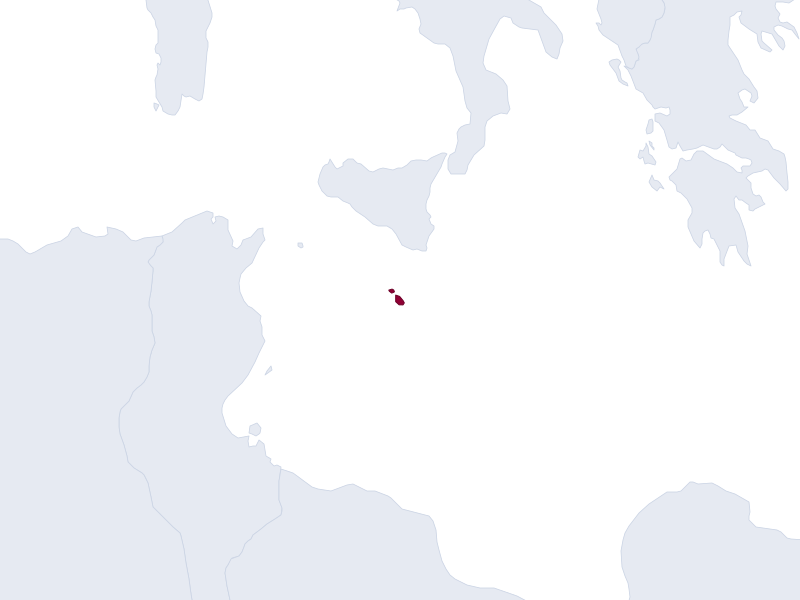
What a repatriation from Malta costs
Malta prices in the Europe, 2 to 4 hours band. The range alongside is bed to bed and all in, covering the ground ambulance at both ends, the UK receiving bed and clinical handover, crew, equipment and oxygen, the seat block or stretcher, handling, landing and permits, the escort return travel and case management. Nothing here is a flight price with extras to follow.
£3,000to£25,000
From a medical escort in an economy seat to an air ambulance, bed to bed and all in.
Figures as at August 2026, from a blend of actual UCS Assist cases and supplier ranges. Ranges are wide because cases are not alike. The full bed-to-bed cost breakdown prices each mode of transport, sets out what moves a case up its band and shows how to sense-check a quote.
Common questions
Is the healthcare in Malta good enough to treat rather than repatriate?
For most of what happens to visitors, yes. The main public hospital is a modern teaching facility, the clinical culture is closely tied to the UK, training and terminology are shared, and everything happens in English, which removes the single biggest source of friction on any other Mediterranean corridor. The ceiling is capability rather than quality. It is a small island system, so for a few highly specialised pathways the patient has to leave, and recognising which those are early is the whole skill on this corridor.
What makes English-speaking care matter so much?
It changes the quality of the clinical information, not just the convenience. On most corridors a UK clinician is working from a translated summary, a partial imaging report and a phone call through an interpreter, and detail is lost at every step. In Malta the treating team can be spoken to directly, in the same clinical vocabulary, about the same guidelines. Fitness to fly assessments are better because the underlying information is better.
How are diving cases handled?
Treatment first, and the order is not negotiable. Gozo and Comino are among the most popular dive sites in the Mediterranean and decompression illness is a regular presentation. It needs recompression locally, and flying too early is the specific hazard because cabin altitude is exactly the exposure that caused the problem. The interval before the patient can fly, and the assessment that clears them, belong to the treating hyperbaric physician and need to be documented rather than assumed.
What is different about a case on Gozo?
The first leg is a boat. Gozo has a hospital for immediate care but the definitive facilities are on the main island, so a serious case is transferred by ferry or by air ambulance helicopter before anything else happens. Sea state, daylight and the ferry timetable are real constraints on when that can occur. A plan built from Malta International has skipped the least predictable part of the journey.
Does the season change anything?
Considerably, and in the direction people do not expect. Summer brings the volume: language students, divers, resort injury. Winter brings the complexity, because the resident and long-stay retiree population is at its largest and oldest exactly when scheduled airline capacity is at its thinnest. A winter repatriation takes longer to arrange and involves a more comorbid patient.
How quickly can a repatriation be arranged?
Once the patient is fit to travel, usually within 24 to 48 hours in season. The sector is short and the case is rarely complicated by language or records. Out of season the constraint becomes scheduled capacity, since there is only one airport and fewer flights to choose from.
Other corridors
Managing a case in Malta?
Our clinical and operational teams are available around the clock. If the case is live, call rather than email.