

Medical repatriation from Italy
Italy is the corridor where the state system is genuinely good, which changes the question. It is rarely whether the patient can be treated locally. It is whether the pathway they now face belongs at home.
2 to 2.5 hours from Milan, Venice or Rome, 3 to 3.5 from Sicily and the far south
A UK GHIC gives access to the state SSN on the same terms as an Italian resident, and it works well here. It has no standing in the private sector and never covers repatriation
What we typically see from Italy
- Ski and snowboard trauma in the Dolomites, the Aosta Valley and the Piedmont resorts, weighted towards knee, shoulder and head injury
- Mountain rescue cases where the retrieval leg is by helicopter and the hospital is a long valley drive from any airport
- Cardiac events and strokes in older cultural tourists, concentrated in Rome, Florence, Venice and the lakes
- Cruise disembarkations at Civitavecchia, Naples, Genoa and the Adriatic ports, often with the ship already sailed
- Road traffic and scooter injury in the cities and on the Amalfi and Ligurian coast roads
- Deterioration of chronic disease in long-stay visitors and in the resident British population in Tuscany and Umbria
The corridor where treating locally is often the right answer
Most repatriation corridors present a version of the same question: can this patient be treated where they are, or do they need to come home? In Italy the answer is more often than not that the local care is entirely capable, particularly in the north, and that the reason to bring somebody home is the pathway waiting for them rather than the treatment in front of them.
That makes Italy a corridor where the discipline is about resisting the reflex. A patient in a good hospital, stable, three days into a definitive treatment, is not a patient who benefits from a flight. The decision to move should turn on rehabilitation, staged surgery, continuity with a UK consultant, or a family and social picture that cannot be sustained abroad, and it should be recorded on those grounds.
The corollary is that the cases which genuinely need moving tend to need moving properly. They are older, more comorbid, and further into a pathway than the equivalent case from a resort corridor.
Two systems, and the SSN is the usual one
Italy runs a national health service that a UK GHIC gives real access to, and unlike some Mediterranean corridors the state system is where most emergency and trauma patients actually end up. Ambulances go to the public hospital. That is a materially different starting position from Spain or Portugal, where a British visitor is frequently taken to a private facility by default.
It changes the commercial picture in the insurer’s favour, and it changes what there is to manage. The exposure on an Italian case is less often an inflating private bill and more often the transport, the ancillary charges around a mountain retrieval, and the length of the case. Where a patient is in the private sector, whether by choice, by proximity or through a resort arrangement, the usual disciplines apply and we manage them through direct billing and clinical challenge on necessity.
Regional variation is real and it is not a criticism. Lombardy, Emilia Romagna and the Veneto have very strong tertiary capability. Parts of the south and the islands are thinner, and a complex case in Calabria or inland Sicily may need transferring within Italy before any conversation about flying home is sensible.
The mountain half of the caseload
Between December and April a large share of Italian cases come off a piste, and they have a shape of their own.
The injuries are familiar: knees, shoulders, wrists, and the head injuries that make the transport decision harder than the surgery. What differs is the geography around them. Retrieval is frequently by helicopter, the receiving hospital is in a valley, and that hospital may be two or three hours by road from Milan or Venice. The flight home is the shortest part of the journey.
Two practical consequences follow. The timeline has to be built bed to bed rather than around a departure slot, because the ground legs dominate it. And helicopter rescue in the Italian resorts is chargeable, billed separately from the hospital account, so it needs identifying while the case is live rather than arriving as a surprise afterwards.
Head injury in particular deserves the slower answer. A patient who is clinically well on the ward may still be some way from being fit for the cabin altitude of a commercial flight, and the interval between those two states is a clinical judgement rather than a scheduling one.
Cruise disembarkations
Italy has more of these than any other European corridor, because it has the ports. Civitavecchia for Rome, Naples, Genoa, and the Adriatic terminals all put passengers ashore, and a passenger landed for medical reasons arrives in a specific and awkward state.
The ship has usually sailed. The clinical record of what happened on board sits with the ship’s medical team, not with the receiving hospital. There is often a travelling companion with nowhere to stay and a booking that ended when the ship left. And the line, the port agent and the insurer are all coordinating separately unless somebody insists otherwise.
None of that is clinically complex. All of it eats days if it is not driven, and days in a hospital bed are the expensive part.
The transport picture
Two to two and a half hours from the northern airports is a forgiving sector with good scheduled capacity, including to UK regional airports rather than only to London.
For a stable patient a commercial stretcher or a seated medical escort is usually both the clinically appropriate answer and the substantially cheaper one. A dedicated air ambulance is right for the ventilated or unstable patient, and for cases where minimising total transfer time is itself the clinical priority, which on a mountain case with a long valley drive it sometimes is.
Sicily and the far south change the arithmetic modestly. The sector is an hour longer, scheduled options are fewer, and the internal transfer to reach a suitable departure airport can be the longest leg of the whole journey.
Before the patient moves
Fitness to travel is assessed against the patient’s actual trajectory by a UK clinician who is accountable for it, and revisited if the picture changes. The UK receiving bed is secured before departure, matched to the consultant and the pathway rather than to the arrival airport. The clinical record reaches the receiving team ahead of the patient, and ground transfers at both ends are arranged and briefed.
Every decision is recorded in Atlas as it is made. For the general picture see medical repatriation and patient transport, and for the corridor with the opposite balance of risk, medical repatriation from the United States.
Where we stage from
The airport a case leaves from is a clinical decision as much as a logistical one, and it is set by where the patient is and what they can tolerate on the ground.
- Milan Malpensa (MXP) and Linate (LIN): the north, the western Alps and the widest scheduled capacity
- Rome Fiumicino (FCO): tertiary referral capability, the cruise catchment at Civitavecchia, and the best long-sector options
- Venice (VCE) and Verona (VRN): the Dolomites and the north east, in ski season the two that matter
- Naples (NAP) and Catania (CTA): the south and Sicily, where the sector is an hour longer and capacity thinner
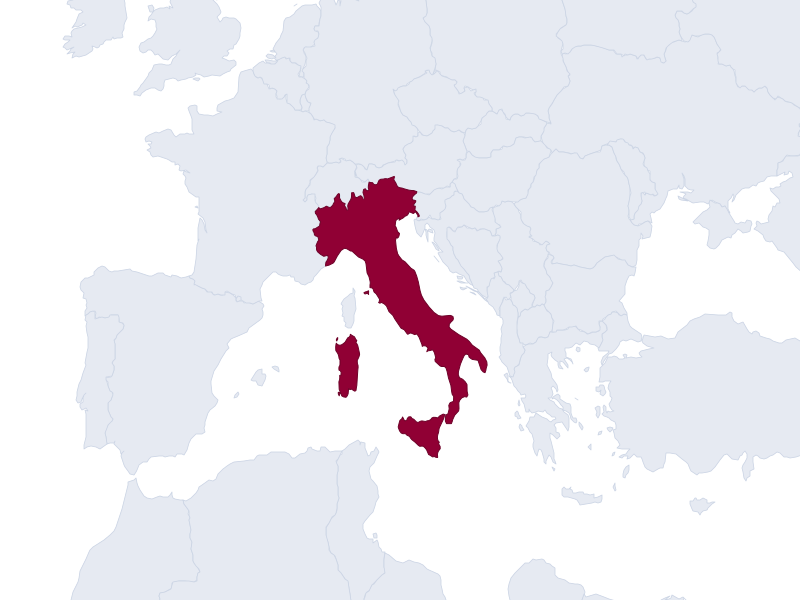
What a repatriation from Italy costs
Italy prices in the Europe, 2 to 4 hours band. The range alongside is bed to bed and all in, covering the ground ambulance at both ends, the UK receiving bed and clinical handover, crew, equipment and oxygen, the seat block or stretcher, handling, landing and permits, the escort return travel and case management. Nothing here is a flight price with extras to follow.
£3,000to£25,000
From a medical escort in an economy seat to an air ambulance, bed to bed and all in.
Figures as at August 2026, from a blend of actual UCS Assist cases and supplier ranges. Ranges are wide because cases are not alike. The full bed-to-bed cost breakdown prices each mode of transport, sets out what moves a case up its band and shows how to sense-check a quote.
Common questions
If Italian hospitals are good, why repatriate at all?
Frequently you should not, and Italy is the corridor where that answer is most often correct. The acute care in the northern regions in particular is genuinely strong. The honest question is about the ongoing pathway rather than the acute episode: where a patient faces weeks of rehabilitation, staged reconstruction, or continuity with a UK consultant, bringing them home is right. Where the definitive treatment can be completed well locally and the patient is not yet fit to travel, moving them early is a clinical risk taken for a commercial reason.
Does a GHIC really cover treatment in Italy?
Inside the state system, yes, on the same basis as an Italian resident. That is a stronger position than it sounds, because the SSN handles emergency and trauma care directly rather than routing foreign patients to private facilities. Two caveats matter. It has no standing at all in a private clinic, which is where some visitors are taken or choose to go, and it never covers the journey home. Establishing which system the patient is actually in, on day one, decides the commercial shape of the case.
What is different about a ski case in the Dolomites?
The retrieval, not the hospital. Mountain rescue is often by helicopter to a valley hospital that is entirely competent but a long drive from a suitable airport, so the ground legs dominate the timeline rather than the flight. Helicopter rescue in the Italian resorts is chargeable and those charges are separate from the hospital account, so they need capturing early rather than surfacing weeks later. Since 2022 skiers on Italian slopes have also been required to hold third party liability cover, which is a different thing from medical cover and is routinely confused with it.
A member has been landed from a cruise ship at Civitavecchia. What changes?
Almost everything about the information flow. The ship has sailed, the clinical record sits with the ship's medical team rather than with the hospital, and the patient arrives with luggage, a travelling companion and no accommodation. Getting the ship's notes, establishing what was done on board and confirming who is coordinating with the line are the first three calls. The clinical case is usually straightforward. The logistics around it rarely are.
Does August affect anything?
It affects elective capacity and it affects scheduling. Italy takes its summer holiday seriously, and around Ferragosto in mid August elective activity thins out while the visitor population is at its peak. Emergency care runs normally. What becomes harder is arranging anything that is not an emergency, including some transfers and some specialist opinions, and scheduled seats and stretcher space are at their scarcest in exactly the same fortnight.
How quickly can a repatriation be arranged?
Once the patient is genuinely fit to travel, usually within 24 to 48 hours from the northern airports. The sector is short and the capacity is good. On mountain and Sicilian cases the constraint is the ground leg and the connection rather than the flight, and it is worth planning the whole journey bed to bed rather than around the departure time.
Other corridors
Managing a case in Italy?
Our clinical and operational teams are available around the clock. If the case is live, call rather than email.