

Medical repatriation from Poland
Poland is the corridor least like a holiday. Most of the caseload is people visiting family, working, or travelling for treatment they arranged themselves, and each of those raises a different question before the clinical one.
2 to 2.5 hours from Warsaw, Krakow, Katowice or Gdansk
A UK GHIC gives access to the public NFZ system on the same basis as an insured resident. The large private sector sits entirely outside it
What we typically see from Poland
- Cardiac events and strokes in older visitors, particularly UK residents visiting family for extended periods
- Complications of privately arranged dental, cosmetic and bariatric procedures, on one of Europe's largest medical tourism corridors
- Occupational injury among UK based workers on contracts in Poland, where the payer is often an employer
- Winter sports injury in the Tatra mountains around Zakopane, at modest volume but with a long ground leg
- Road trauma on long drives, including on the coach and minibus routes used by the diaspora
- Deterioration of chronic disease in patients who spend months at a time in Poland and keep a UK GP
A corridor that runs both ways
Most repatriation corridors describe British people going somewhere warm. Poland describes something else: a dense, year-round two-way flow of people with lives in both countries.
That shapes every case. The patient is far more likely to be staying with family than in a hotel, more likely to be in the country for weeks rather than days, and more likely to have a settled relationship with the NHS that makes continuity of care a real argument rather than a preference. When a stroke happens in week three of a stay with a daughter in Krakow, the pathway that matters is the one waiting in the UK.
It also means the practical business of a case is easier than the distance suggests. There is usually a family member present who knows the history and can speak to the treating team. That is worth more than it sounds when the alternative, on most corridors, is a translated summary and a guess.
Three populations, three first questions
Visiting family. Older patients, long stays, extensive medication lists, chronic disease that was stable at home. The case mix is cardiac events, strokes and falls rather than trauma, and the transfer decision usually turns on rehabilitation rather than on the acute episode.
Working. UK based workers on contracts, particularly in the industrial south west. Here the payer may be an employer, a project policy or a statutory scheme rather than a travel insurer, and a case where three parties each assume another is handling the guarantee of payment simply stops while the bed fills.
Travelling for treatment. Poland is one of Europe’s largest destinations for privately arranged dental, cosmetic and bariatric surgery. Some of those patients become unwell afterwards.
The medical tourism problem
That third group is the awkward one for an insurer, and it recurs often enough here to deserve a process rather than an improvisation.
The elective procedure is usually excluded. The complication presents as an emergency and may not be. The member almost never understood that these are treated differently, and frequently believes the two are the same thing because they happened to the same body in the same week.
The way through is to separate the conversations early and hold both in writing. Establish what was done, where and when. Establish what is being treated now and whether it is a consequence. Give the member a plain answer rather than a deferred one, because a dispute discovered at invoice stage costs more than the same dispute settled on day two and costs the relationship as well. The same pattern appears on the Mexico corridor, for the same underlying reason.
Two systems
The public NFZ system is where emergency care goes and where a UK GHIC has real effect, on the same basis as an insured resident.
Alongside it sits a large and growing private sector, used by preference by many patients and by definition by every medical tourism case. The card has no standing there at all. Establishing which system the patient is actually in, on day one, sets the commercial shape of the entire case, as set out in who actually pays, and when.
Before the patient moves
Fitness to travel is assessed against the patient’s actual trajectory by a UK clinician who is accountable for it, and revisited if the picture changes. The UK receiving bed is secured before departure, matched to the consultant and the pathway rather than to the arrival airport. The clinical record reaches the receiving team ahead of the patient, and ground transfers at both ends are arranged and briefed.
Every decision is recorded in Atlas as it is made. For the general picture see medical repatriation and patient transport, and for the other corridor where the payer is frequently an employer, medical repatriation from Germany.
Where we stage from
The airport a case leaves from is a clinical decision as much as a logistical one, and it is set by where the patient is and what they can tolerate on the ground.
- Warsaw (WAW): the deepest tertiary capability in the country and the widest scheduled capacity
- Krakow (KRK): the south, the Tatra catchment and a large share of the medical tourism caseload
- Katowice (KTW) and Wroclaw (WRO): the industrial south west, relevant to occupational cases
- Gdansk (GDN): the north and the coast
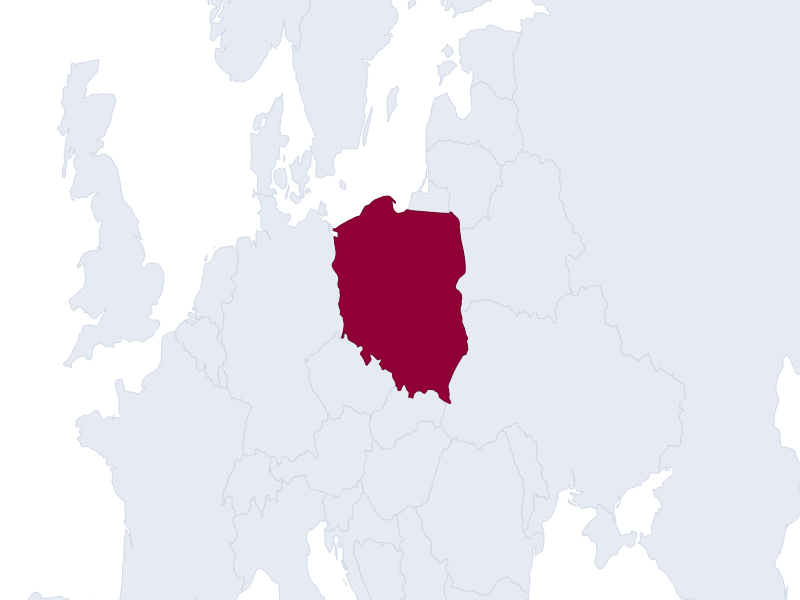
What a repatriation from Poland costs
Poland prices in the Europe, 2 to 4 hours band. The range alongside is bed to bed and all in, covering the ground ambulance at both ends, the UK receiving bed and clinical handover, crew, equipment and oxygen, the seat block or stretcher, handling, landing and permits, the escort return travel and case management. Nothing here is a flight price with extras to follow.
£3,000to£25,000
From a medical escort in an economy seat to an air ambulance, bed to bed and all in.
Figures as at August 2026, from a blend of actual UCS Assist cases and supplier ranges. Ranges are wide because cases are not alike. The full bed-to-bed cost breakdown prices each mode of transport, sets out what moves a case up its band and shows how to sense-check a quote.
Common questions
Who is actually travelling on this corridor?
Not many holidaymakers. The bulk is people visiting family, people working, and people who travelled specifically for private treatment. That changes the first questions. A visiting friends and relatives patient is usually older, staying for weeks, with a long medication list and a family member present who knows the history. A working patient may have an employer or a project policy as the real payer. A medical tourism patient has a coverage position that needs establishing before anything else.
A member had dental or cosmetic surgery in Poland and is now unwell. Where does that leave us?
In a clinical conversation and a coverage conversation at the same time, and they need keeping separate. Poland is one of the largest destinations in Europe for privately arranged dental, cosmetic and bariatric work, and complications are a recurring presentation. The elective procedure is commonly excluded while the acute emergency that presents may not be, and the member rarely understood that distinction when they booked. Establish the position early, in writing, and give them a plain answer rather than a deferred one.
Does a GHIC work in Poland?
Within the public NFZ system, yes, on the same basis as an insured resident, and that covers the emergency caseload properly. The complication is the large and growing private sector, which many patients use by preference and which sits entirely outside the card. Since the medical tourism caseload is by definition private, a significant share of this corridor's cases have no state cover at all.
Is the care good enough to treat rather than repatriate?
In the major centres, generally yes. Warsaw and Krakow have genuine tertiary capability and the private hospitals serving foreign patients are used to the relationship. The honest question is the usual one about the ongoing pathway. What tips this corridor towards moving the patient more often than Germany does is that the sector is short and many of these patients have a UK GP, UK consultant and UK family, so continuity genuinely argues for home.
How quickly can a repatriation be arranged?
Once the patient is fit to travel, usually within 24 to 48 hours. Scheduled capacity to the UK is good on this corridor given the volume of traffic between the two countries. Obtaining a complete clinical record is generally straightforward from the public system and more variable from private clinics.
Other corridors
Managing a case in Poland?
Our clinical and operational teams are available around the clock. If the case is live, call rather than email.