

Medical repatriation from Ireland
Ireland is the corridor most often assumed to be simple. The distances are short and the systems are familiar, which is exactly why cases here get left to drift while more distant ones get managed.
1 to 1.5 hours from Dublin, Cork or Shannon, with road and ferry a genuine alternative rather than a fallback
Common Travel Area arrangements give UK residents access to necessary treatment in the Irish public system. Private hospitals sit outside it, and nothing covers the journey home
What we typically see from Ireland
- Cardiac events and strokes in visiting family, on a corridor with more visiting friends and relatives traffic than any other
- Fragility fractures in older visitors, where the rehabilitation pathway rather than the injury decides the transfer
- Road trauma on rural routes, sometimes a long ground leg from the nearest major hospital
- Deterioration of chronic disease in long-stay visitors and in patients who moved across and kept a UK consultant
- Golf, equestrian and watersports injury, concentrated in the west and south west in season
- Patients who travelled to Ireland for private treatment and need bringing back afterwards
The corridor that gets overlooked because it looks easy
Ireland generates a steady caseload and almost no drama. The hospitals are good, the language is shared, the systems are recognisable, the distances are short, and a British patient in Cork is a great deal closer to home than one in Faro.
That is precisely why cases here go wrong. Not clinically, but through neglect. An assistance desk holding a difficult case in Bangkok and a straightforward one in Galway will work the Bangkok case, and the Galway patient sits in a bed for three extra days because nobody drove it. On a corridor this short, those days are pure waste: no clinical benefit, real cost, and a patient and family wondering why nothing is happening.
The discipline this corridor needs is not expertise. It is ownership.
The Common Travel Area, and what it does not reach
Arrangements between the UK and Ireland give UK residents access to necessary treatment in the Irish public system. In practice that covers much of the emergency caseload, and it is the reason many Irish cases produce modest exposure.
Two gaps matter. A patient treated in a private hospital, whether by choice, by proximity or because that is where they were taken, sits outside the arrangement entirely and is in a straightforward private billing relationship. And nothing about it touches repatriation, which on most cases here is the largest line on the account.
As everywhere, the useful first question is which system the patient is actually in, asked on day one rather than day four. The reasoning is the same as in who actually pays, and when.
Where road beats flying
This is the corridor where the transport answer most often is not an aircraft.
A road ambulance with a ferry crossing gives a genuine bed to bed transfer. The patient is moved once, at the start, and once at the end. There is no airport, no airside transfer, no aircraft cabin, no change of vehicle, and no cabin altitude to think about. For an older patient with a fractured neck of femur, or anyone for whom altitude is the specific clinical problem, that is not a compromise on flying, it is a better plan than flying.
It costs hours. It removes most of the ways a transfer goes wrong, which is where transfers actually go wrong, as set out in what good repatriation actually looks like.
Flying still wins in three situations: the patient is unstable and time matters, the case is from the far south west where the ground leg to a port is itself long, or the receiving unit is a long way from any British port. The point is that on this corridor the aircraft has to earn its place rather than being assumed.
A visiting friends and relatives caseload
More of this corridor’s traffic is people staying with family than people in hotels, and that shapes the cases.
Patients tend to be older. They are often staying for weeks rather than days. Their chronic conditions travel with them, and their medication lists are long. When something happens, there is usually a family member present who knows the history, which is a genuine advantage, and there is frequently no travel policy at all, which is not.
The result is a case mix weighted towards cardiac events, strokes, falls and decompensation rather than trauma, and a repatriation decision that turns on the rehabilitation pathway more often than on the acute injury.
Before the patient moves
Fitness to travel is assessed against the patient’s actual trajectory by a UK clinician who is accountable for it, and revisited if the picture changes. The UK receiving bed is secured before departure, matched to the consultant and the pathway rather than to the arrival airport. The clinical record reaches the receiving team ahead of the patient, and ground transfers at both ends are arranged and briefed.
Every decision is recorded in Atlas as it is made. For the general picture see medical repatriation and patient transport, and for the other corridor where road transfer is the default rather than the exception, medical repatriation from France.
Where we stage from
The airport a case leaves from is a clinical decision as much as a logistical one, and it is set by where the patient is and what they can tolerate on the ground.
- Dublin (DUB): the highest case volume, the widest scheduled capacity and the shortest sectors
- Cork (ORK) and Shannon (SNN): the south and west, where the ground leg to reach them is often the longer half
- Belfast (BFS, BHD): a land transfer for cases in the north west, with no flight required at all
- Rosslare and Dublin Port: the ferry routes, which make a road ambulance transfer realistic for a stable patient
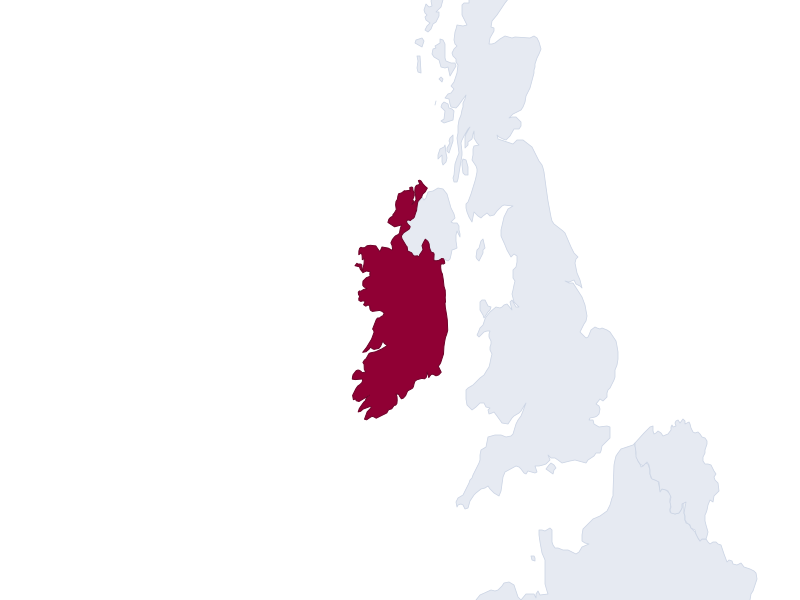
What a repatriation from Ireland costs
Ireland prices in the Europe, 2 to 4 hours band. The range alongside is bed to bed and all in, covering the ground ambulance at both ends, the UK receiving bed and clinical handover, crew, equipment and oxygen, the seat block or stretcher, handling, landing and permits, the escort return travel and case management. Nothing here is a flight price with extras to follow.
£3,000to£25,000
From a medical escort in an economy seat to an air ambulance, bed to bed and all in.
Figures as at August 2026, from a blend of actual UCS Assist cases and supplier ranges. Ranges are wide because cases are not alike. The full bed-to-bed cost breakdown prices each mode of transport, sets out what moves a case up its band and shows how to sense-check a quote.
Common questions
Does a UK patient get free treatment in Ireland?
Common Travel Area arrangements give UK residents access to necessary treatment in the Irish public system, which covers a great deal of the emergency caseload. Two things still catch people out. Private hospitals sit entirely outside that, and a patient who is taken to or chooses one is in an ordinary private billing relationship. And nothing in the arrangement covers the journey home, which on most cases is the largest single cost.
Is it worth flying at all on this corridor?
Frequently not. For a stable patient a road ambulance with a ferry crossing gives a true bed to bed transfer with no airport, no transfers between vehicles and no cabin altitude. It takes longer measured in hours and it removes most of the moving parts, which for an older patient with a fractured hip is usually the better clinical trade. Flying wins where time genuinely matters, where the patient is unstable, or from the far south west where the ground leg to a port is itself substantial.
Why does an easy corridor need managing at all?
Because familiarity produces drift. Everyone assumes an Irish case will sort itself out, so it goes to the bottom of the pile behind Thailand and Mexico, and a patient who could have been home on Tuesday is still occupying a bed on Friday. The clinical decisions are usually simple here. The failure mode is not complexity, it is nobody owning it.
What about a patient in Northern Ireland?
That is a domestic transfer within the UK rather than a repatriation, and it is worth saying because cases from the north west of the island sometimes present as international ones. The practical planning is the same: a receiving bed matched to the pathway, a clinical handover between named teams, and ground transport arranged at both ends. The paperwork is simply much lighter.
How quickly can a transfer be arranged?
Usually within 24 hours of the patient being fit to travel, and sometimes the same day by road. The constraint is almost never transport. It is clinical stability, obtaining the discharge summary and imaging from the treating team, and securing the right UK receiving bed.
Other corridors
Managing a case in Ireland?
Our clinical and operational teams are available around the clock. If the case is live, call rather than email.