

Medical repatriation from Egypt
Egypt's cases cluster in resort towns several hundred kilometres from the country's best hospitals. The first decision is almost never about the flight home.
5 to 5.5 hours from Hurghada or Sharm el-Sheikh, 5 from Cairo
No reciprocal arrangement. Treatment is chargeable and hospitals usually require payment or a guarantee upfront
What we typically see from Egypt
- Diving incidents including decompression illness, concentrated around the Red Sea resorts, where flying before treatment and clearance is actively dangerous
- Severe gastrointestinal illness and dehydration, which is high volume and occasionally serious enough to need admission
- Quad bike, camel and desert excursion trauma, frequently uninsured through activity or licensing exclusions
- Road traffic collisions on the long resort transfer routes, sometimes involving whole tour groups
- Cardiac events in the older Nile cruise and cultural tour market
- Watersports and snorkelling incidents including near-drowning and marine envenomation
The geography is the problem
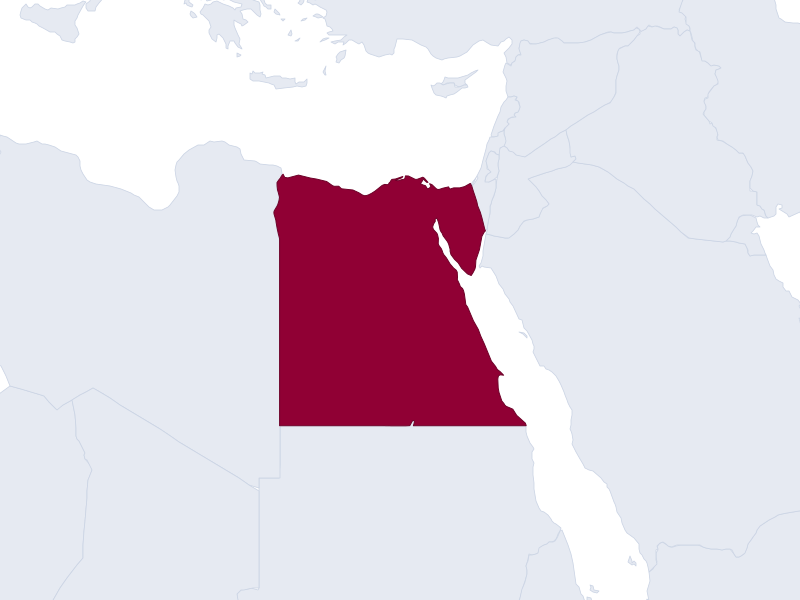
Egypt’s tourist economy and Egypt’s best hospitals are in different places. The Red Sea resorts sit several hundred kilometres from Cairo, and the Nile cruise route further still.
That shapes every serious case. The question is rarely “how do we get this patient to the UK”. It is “where does this patient need to be treated, and how do we get them there safely”, and only then does the flight home arise.
Getting that first leg right is the single most valuable thing an assistance provider does on this corridor, and it is the one most often subcontracted and forgotten.
Diving, and the case where flying is the danger
The Red Sea is one of the world’s major diving destinations, and decompression illness is the case type that defines this corridor.
It is also the category where the reflex to fly a patient home immediately causes direct, sometimes permanent harm. A patient with DCI needs recompression treatment and a clear post-treatment interval before flight is safe. Ascending to cabin altitude too soon can convert a treatable injury into a lasting one.
Hurghada and Sharm el-Sheikh both have hyperbaric facilities, which is a genuine advantage of this corridor over many others. We coordinate with the treating unit and set the flight window from the clinical picture. The general principle applies with unusual force here: the medicine sets the timing, and the aircraft waits.
Resort medicine, and where it ends
The private hospitals serving the Red Sea resorts are used to insured foreign patients and handle a great deal competently, including diving medicine and the routine gastrointestinal and orthopaedic presentations that make up most of the volume.
Where they end is complex trauma, neurosurgery, interventional cardiology and intensive care depth. A serious road traffic collision or an intracranial bleed in Hurghada is a Cairo problem, and moving the patient there is a clinical transfer requiring the right escort, equipment and mode.
Assuming “there is a hospital in the resort” is not a plan. Establishing what that hospital can actually do, before a patient is committed to it, is part of the clinical work.
Guarantees of payment, and why scope matters
There is no reciprocal healthcare arrangement with Egypt. Treatment is chargeable from the outset, and hospitals will generally require payment or a guarantee before proceeding beyond stabilisation.
A guarantee issued with defined scope, meaning this indication and this proposed pathway with any extension requiring a fresh decision, gets the member treated without paying upfront while establishing what has been authorised before treatment begins. Issued open-ended in a private market, it is a blank cheque. The difference costs nothing to implement.
The exclusions conversation, held early
Quad bikes, camel rides and desert excursions produce a steady share of this corridor’s trauma, and a steady share of declined claims. Many policies will not respond where the member was not licensed for a motorised vehicle, and organised excursions rarely involve any licence check.
That needs establishing in the first hours. A family told in week three what they should have been told on day one has a legitimate complaint, and it is the kind of complaint that reaches a regulator. Where cover does not respond, the member still needs clinically safe advice and a route home.
The flight home
Five to five and a half hours from the Red Sea resorts is a middle-distance sector, comfortably within commercial stretcher range where capacity allows, though scheduled availability from resort airports is thinner than from Cairo and varies considerably by season.
For most stable patients a stretcher or a seated medical escort is appropriate, and staging through Cairo widens the options considerably. A dedicated air ambulance is right for the ventilated or unstable patient, and for cases where a long ground transfer to Cairo would itself be the greater risk.
Before the patient moves
Fitness to travel is assessed against the patient’s actual trajectory by a UK clinician who is accountable for it. The UK receiving bed is secured before departure, matched to the pathway required. The clinical record reaches the receiving team ahead of the patient, and every leg, including the resort-to-Cairo transfer, is coordinated rather than subcontracted and hoped for.
Every decision is recorded in Atlas as it is made. For the general picture see medical repatriation and patient transport.
Where we stage from
The airport a case leaves from is a clinical decision as much as a logistical one, and it is set by where the patient is and what they can tolerate on the ground.
- Hurghada (HRG): the largest Red Sea resort catchment, with a hyperbaric facility and private hospitals used to insured patients
- Sharm el-Sheikh (SSH): Sinai resorts and dive sites, with its own hyperbaric capability
- Cairo (CAI): the country's tertiary hospitals and the widest scheduled stretcher availability
- Luxor (LXR) and Aswan (ASW): the Nile cruise corridor, where cases usually stage through Cairo
What a repatriation from Egypt costs
Egypt prices in the Medium haul, 5 to 8 hours band. The range alongside is bed to bed and all in, covering the ground ambulance at both ends, the UK receiving bed and clinical handover, crew, equipment and oxygen, the seat block or stretcher, handling, landing and permits, the escort return travel and case management. Nothing here is a flight price with extras to follow.
£5,000to£30,000
From a medical escort in an economy seat to an air ambulance, bed to bed and all in.
Figures as at August 2026, from a blend of actual UCS Assist cases and supplier ranges. Ranges are wide because cases are not alike. The full bed-to-bed cost breakdown prices each mode of transport, sets out what moves a case up its band and shows how to sense-check a quote.
Common questions
What happens with a diving injury in the Red Sea?
Decompression illness is the defining case type on this corridor, and the one where the instinct to fly the patient home immediately does direct harm. The patient needs recompression treatment and a defined interval afterwards before flight is safe, and that interval is a clinical judgement rather than a fixed rule. Hurghada and Sharm el-Sheikh both have hyperbaric facilities. We coordinate with the treating unit and set the flight window from the clinical picture, not from the aircraft availability.
How good is the medical care in the resorts?
Variable, and the variation matters. The private hospitals serving Hurghada and Sharm el-Sheikh are accustomed to insured foreign patients and can manage a great deal, including diving medicine. Complex trauma, neurosurgery and interventional cardiology generally mean a transfer to Cairo. Establishing what the receiving facility can actually do, before committing a patient to it, is a clinical task and we treat it as one.
Is a GHIC any use in Egypt?
No. There is no reciprocal healthcare arrangement. Treatment is chargeable from the outset and hospitals will typically require payment or a guarantee of payment before proceeding beyond immediate stabilisation. We issue guarantees with defined scope at the point of need, so the member is treated without paying upfront and the exposure is scoped before treatment runs.
Are quad bike and desert excursion injuries covered?
Often not, and it needs establishing in the first hours rather than the third week. Many travel policies exclude motorised vehicles the member was not licensed for, and organised desert excursions rarely involve any licence check. Where cover does not respond the member still needs safe clinical advice and a route home, and we will say so plainly rather than disengage.
Can you move a patient from a resort to Cairo?
Yes, and on this corridor it is frequently the decision that matters most. The resort-to-Cairo leg is several hundred kilometres and is a clinical transfer in its own right, by road or by air depending on the patient and the urgency. We coordinate and escort it as part of a continuous transfer rather than treating it as travel to be arranged locally.
Do you handle repatriation of remains from Egypt?
Yes, including the documentation, mortuary liaison and consular requirements. The process has its own timescales and paperwork and benefits considerably from being started early.
Other corridors
Managing a case in Egypt?
Our clinical and operational teams are available around the clock. If the case is live, call rather than email.