

Medical repatriation from India
India has some of the best hospitals in Asia and some of the most limited, sometimes a few hours' drive apart. Which one your member reached is the single most important fact about the case.
9 to 10 hours direct from Delhi or Mumbai, longer from the south with a connection
No reciprocal arrangement. Private hospitals require a guarantee of payment or a deposit
What we typically see from India
- Acute presentations in the visiting friends and relatives population, often older travellers staying in towns and villages away from the metros
- Cardiac events and strokes, frequently in patients with pre-existing disease and incomplete medication records
- Road traffic collisions, including on the long inter-city routes and involving two-wheelers
- Severe gastrointestinal illness, dehydration and enteric fever, occasionally progressing to sepsis
- Complications of elective treatment in the medical tourism sector, including orthopaedic and cardiac surgery
- Respiratory deterioration in patients with existing lung disease, particularly during the northern winter air quality season
The range is the defining fact
Most corridors have a broadly consistent standard of care that you can plan around. India does not, and pretending otherwise is how cases go wrong here.
The major private hospitals in Delhi, Mumbai, Bengaluru and Chennai are internationally accredited, staffed by consultants many of whom trained or practised in the UK, and capable of cardiac surgery, neurosurgery and complex oncology to a standard that needs no apology. A patient who reaches one of them is in good hands.
A patient taken ill in a smaller town, several hours from a metro, may be somewhere with no intensive care, no CT and no surgical cover. Both situations are “a case in India”.
So the first question on this corridor is never about the flight. It is: where exactly is the patient, what can that facility actually do, and does the patient need moving within India before anything else is considered?
Visiting friends and relatives
The largest serious case category from India is not the holidaymaker. It is the member visiting family, and it behaves differently from almost anything else in the assistance book.
The patient is often older and frequently has pre-existing cardiac, respiratory or metabolic disease. They may be staying in a town or village rather than a hotel, with no tour operator and no local infrastructure around them. Medication histories are often incomplete, sometimes because they travelled with a few weeks of tablets and no list of what they were.
Communication runs through relatives, who are also interpreting for the treating team and managing their own distress. That is a demanding position to put a family in, and it is one of the places where having a single named clinical lead who holds the whole picture makes the most difference, as set out in complex case management.
These cases also tend to present late. Somebody who feels unwell while staying with family will often wait, and the presentation when it comes is further along than it would have been at home.
Distance, and what it does to the decision
Nine to ten hours direct from Delhi or Mumbai is long-haul, and the sector length dominates the clinical planning in the way it does from Thailand: oxygen quantity, immobility and thromboembolic risk, infusions across a full duty period, escort fatigue, and no useful diversion for much of the route.
A patient entirely fit for a European sector may need several more days before this one is safe. Assessing that against the patient’s trajectory rather than the pressure to move is the judgement that matters most.
Most dedicated air ambulance aircraft cannot make India to the UK in one leg, so an air ambulance here means either a long-range jet or one or more technical stops, each adding ground time and a pressure cycle. Against that, Delhi and Mumbai have genuinely good scheduled stretcher capacity, so for a stable patient the commercial option is very often both clinically appropriate and far cheaper.
From the south, most cases stage through a metro first, and that domestic leg needs planning as clinical transport rather than treated as travel.
Sometimes the right answer is to complete treatment there
Where a member has reached a major private hospital and the definitive treatment can be completed to a good standard, doing so and then repatriating a recovered patient is frequently safer and very substantially cheaper than moving a sick one across a ten-hour sector.
The test is the ongoing pathway. If the patient will need months of rehabilitation, staged reconstruction, or continuity with a UK consultant, bring them home. If the acute episode can be finished well where they are, finishing it is usually the better clinical decision, and it happens to be the better commercial one too. That is what cost containment through clinical challenge looks like when it is done honestly.
Elective treatment and its complications
India’s medical tourism sector is large and, in the major centres, genuinely good. As with anywhere, a complication of elective treatment the member travelled to receive raises a coverage question that most policies answer in the negative, and it needs establishing in the first hour rather than the first week.
Clinically these cases need the operative detail before anything else is decided. A receiving surgeon planning without an operative note is planning blind, and telling them so honestly is more useful than an optimistic assumption.
Before the patient moves
Fitness to travel is assessed against the patient’s actual trajectory by a UK clinician who is accountable for it, and revisited as the picture changes. The UK receiving bed is secured before departure and matched to the pathway required. The clinical record, imaging and medication history reach the receiving team ahead of the patient. Every leg, including any domestic transfer within India, is coordinated rather than subcontracted.
Every decision is recorded in Atlas as it is made. For the general picture see medical repatriation and patient transport, and for the other long-haul corridor where distance dominates, medical repatriation from Thailand.
Where we stage from
The airport a case leaves from is a clinical decision as much as a logistical one, and it is set by where the patient is and what they can tolerate on the ground.
- Delhi (DEL): the widest scheduled stretcher availability in the country and the strongest tertiary capability
- Mumbai (BOM): tertiary hospitals and good direct UK connectivity
- Bengaluru (BLR) and Chennai (MAA): major private hospital hubs and the centre of the medical tourism sector
- Kochi (COK) and Hyderabad (HYD): regional catchments where cases usually stage through a metro
- Amritsar (ATQ) and Ahmedabad (AMD): significant for the visiting friends and relatives caseload
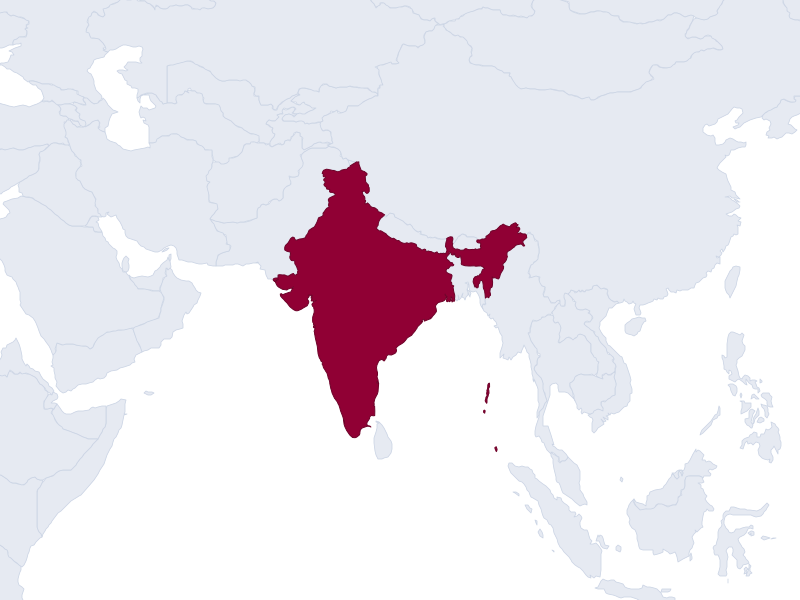
What a repatriation from India costs
India prices in the Long haul, 9 hours plus band. The range alongside is bed to bed and all in, covering the ground ambulance at both ends, the UK receiving bed and clinical handover, crew, equipment and oxygen, the seat block or stretcher, handling, landing and permits, the escort return travel and case management. Nothing here is a flight price with extras to follow.
£8,000to£75,000
From a medical escort in an economy seat to an air ambulance, bed to bed and all in.
Figures as at August 2026, from a blend of actual UCS Assist cases and supplier ranges. Ranges are wide because cases are not alike. The full bed-to-bed cost breakdown prices each mode of transport, sets out what moves a case up its band and shows how to sense-check a quote.
Common questions
Is Indian healthcare good enough to treat rather than repatriate?
In the major private hospitals in Delhi, Mumbai, Bengaluru and Chennai, absolutely. These are internationally accredited institutions with cardiac, neurosurgical and oncological capability that stands comparison with anywhere. The difficulty is that the range across the country is enormous, and a member taken ill in a smaller town may be at a facility with very limited capability. Establishing which situation you are actually in is the first job, and it cannot be assumed from the country.
What is different about visiting friends and relatives cases?
Almost everything. The patient is often older, frequently has pre-existing disease, may be staying somewhere well away from a metro, and is being cared for by family rather than a hotel or a tour operator. Medication histories are often incomplete, sometimes because the patient travelled with a few weeks of tablets and no list. Communication runs through relatives who may be interpreting for the treating team. It is the most common serious case type on this corridor and the least like a holiday case.
Can a patient tolerate a ten-hour flight?
Many can, and many need more time first. The sector is long enough that it dominates the clinical planning: total oxygen requirement, thromboembolic risk in a patient who may already be immobile, infusion management across a full duty period, and escort fatigue. A patient who would be entirely fit for a European sector may need several more days of stabilisation before this one is safe.
Will an air ambulance fly direct?
Usually not in a single leg. Most dedicated air ambulance aircraft need at least one technical fuel stop between India and the UK, which adds ground time and a descent and climb cycle the patient has to tolerate. Long-range aircraft exist but are expensive and less available. Against that, Delhi and Mumbai have genuinely good scheduled stretcher capacity to the UK, so for a stable patient the commercial option is often both appropriate and dramatically cheaper.
How do guarantees of payment work?
Private hospitals will generally require a guarantee of payment or a deposit before proceeding beyond stabilisation, and they are accustomed to dealing with foreign insurers. We issue guarantees with defined scope at the point of need, which gets the member treated without paying upfront and establishes what is authorised before treatment begins.
What about the medical tourism sector?
India has a large and generally high-quality medical tourism sector, particularly in orthopaedics and cardiac surgery. As with any elective treatment abroad, the coverage position needs establishing immediately, because most policies exclude treatment the member travelled specifically to receive and complications arising from it. Clinically these cases need the operative detail before anything else is decided.
Other corridors
Managing a case in India?
Our clinical and operational teams are available around the clock. If the case is live, call rather than email.