
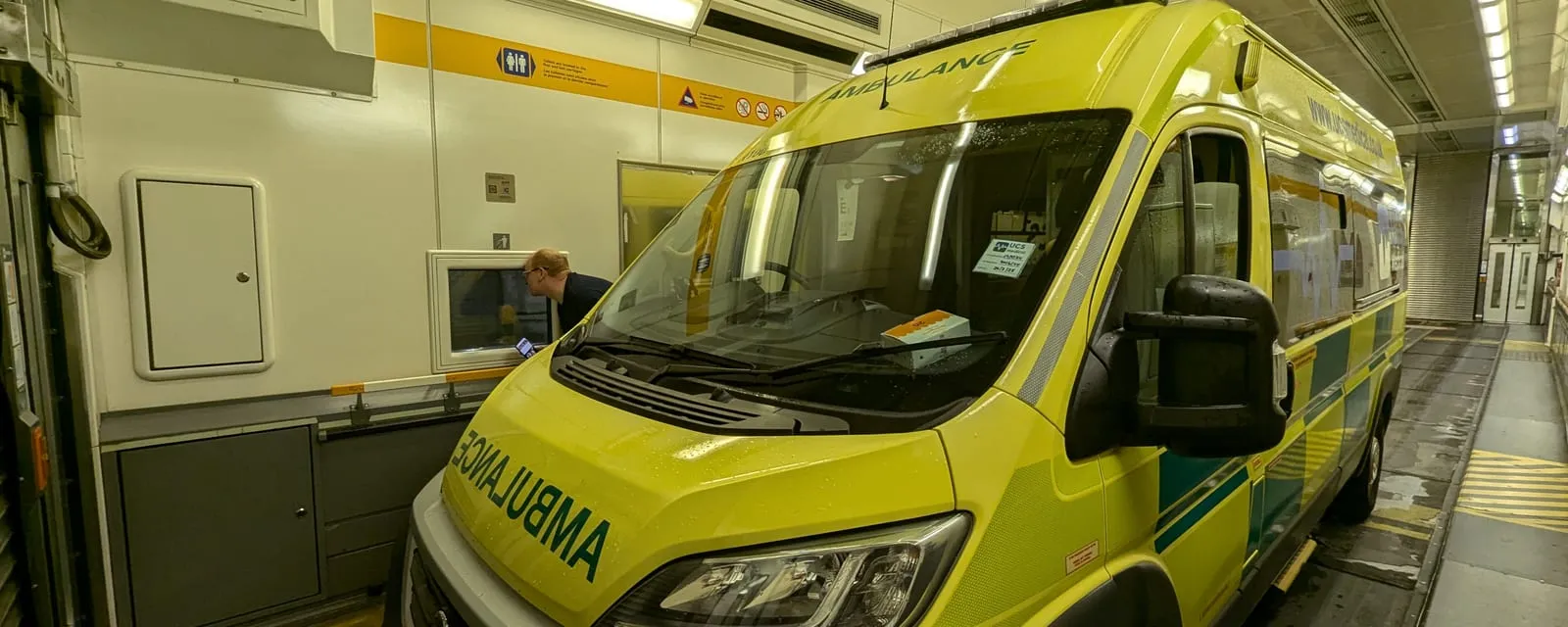
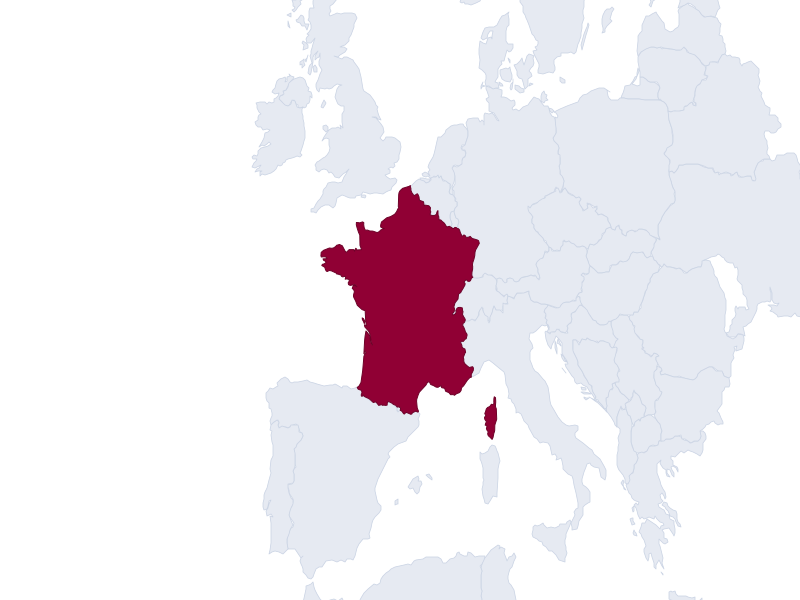
Medical repatriation from France
France is the one corridor where the aircraft is frequently the wrong answer. A road ambulance through the tunnel avoids two transfers, an altitude change and an airport.
1 to 1.5 hours by air; 6 to 9 hours bed to bed by road via the tunnel from northern France
A UK GHIC covers state healthcare, with the French co-payment still applying
What we typically see from France
- Ski and snowboard trauma through the Alpine season, dominated by knee, shoulder and head injuries
- Road traffic collisions on the long autoroute drives, often with a whole family involved
- Cardiac events and strokes in the resident British population in Normandy, Brittany, the Dordogne and the south
- Cycling injuries, both recreational and sportive, in the summer months
- Acute presentations in second-home owners who spend months at a time in France without local cover
The corridor where the aircraft is usually optional
Every other corridor starts with the question of which aircraft. France starts with the question of whether an aircraft is needed at all, and often the honest answer is no.
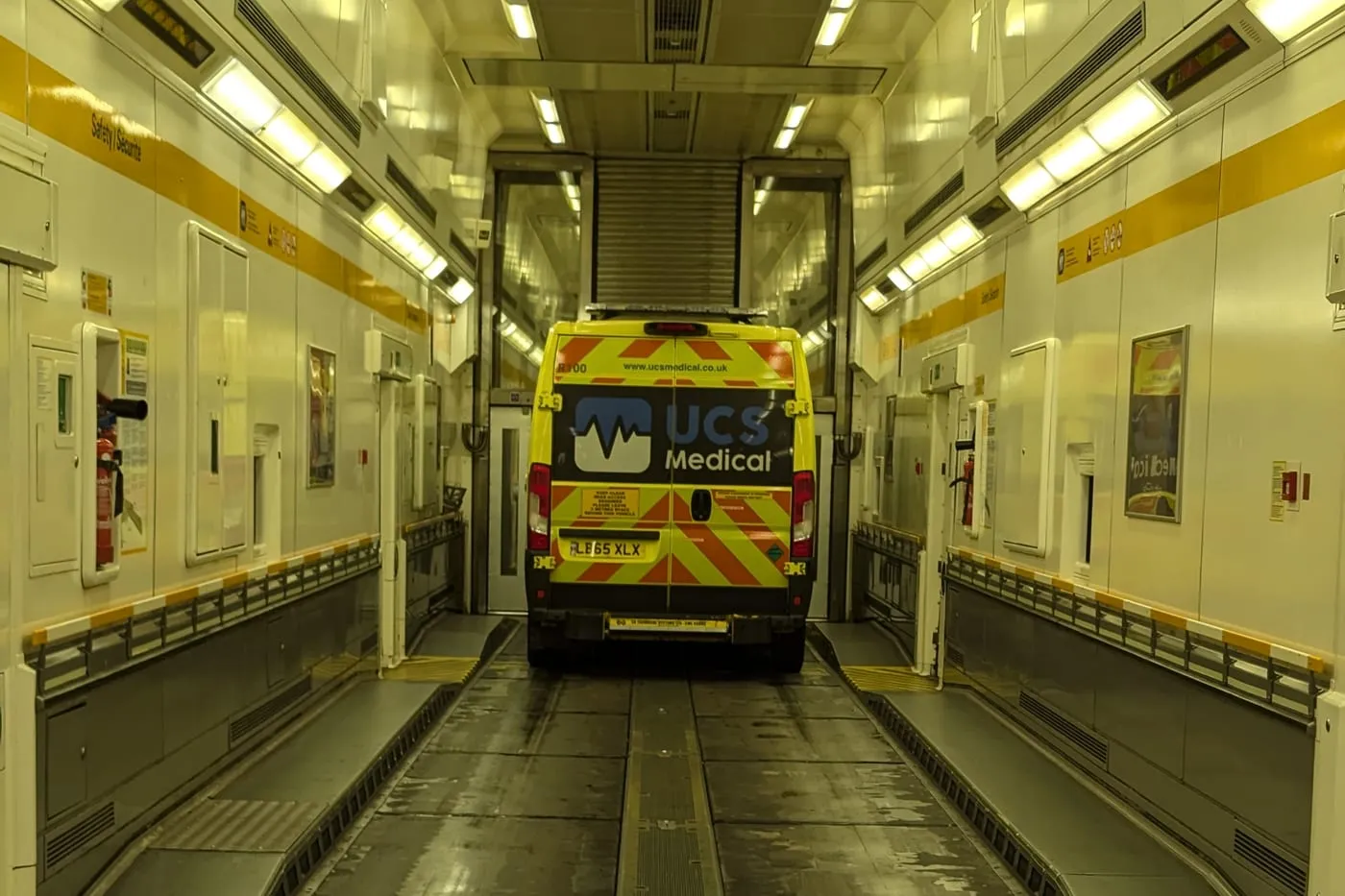
The Channel Tunnel makes a road transfer from northern and central France a genuinely practical clinical option, and for a substantial share of cases it is the better one. Not merely cheaper. Better.
Why road can beat air on a short corridor
A flight looks faster because people count the sector rather than the journey. The real comparison is bed to bed.
Flying a patient home from Paris means: hospital bed to ambulance, road to the airport, airside transfer, onto the aircraft, a cabin altitude change and back down, off the aircraft, receiving ambulance, road to the UK hospital. That is four separate transfers and a pressure cycle.
A road repatriation through the tunnel is one vehicle, one clinical team, one continuous period of observation, no altitude change, and the patient is moved twice: out of one bed and into another.
For some patients that difference is decisive. A spinal injury being managed with log-roll precautions, a patient in an external fixator, a chest injury where a pressure change is unhelpful, or simply somebody in a lot of pain who does not need four handovers. The clinical argument for road on this corridor is genuinely strong, and it is frequently overlooked because road ambulance is thought of as local transport rather than repatriation.
It is not always right. From Nice or Toulouse the drive is long enough that flying wins, and for an unstable patient the speed matters more than the smoothness. But it should be a decision, not a default.
The Alps in season
Through the ski season the Alps produce the bulk of this corridor: knee and shoulder injuries, fractures, head injuries, the occasional serious polytrauma. Resort clinics and valley hospitals in France handle orthopaedic trauma extremely well, and there is rarely any concern about the standard of acute care.
The interesting decision is about definitive treatment. A cruciate reconstruction or a complex fracture fixation carries months of rehabilitation behind it. Doing the surgery in France and the rehabilitation in the UK splits the pathway across two teams who will never speak to each other. Where the patient is stable and the injury can wait, bringing them home for both is often the better clinical answer, and it is a conversation worth having early rather than after the operating list is booked.
Geneva is frequently the practical staging point for the northern Alps, and it is worth remembering the patient may be treated in one country and flown from another.
The GHIC gap people fall into
France is a good system to be ill in, and a GHIC gives real access to it. The gap is the co-payment. French state healthcare reimburses a proportion of the cost rather than all of it, with the patient liable for the balance and usually a daily hospital charge as well.
Members who have understood their GHIC as full cover are frequently surprised, and it is worth establishing early so the conversation happens before the bill rather than after. And as everywhere, the GHIC does nothing at all for repatriation.
Family incidents
The long drive south is a particular feature of this corridor, and so is the multi-casualty road traffic collision that comes with it. Four family members, potentially at two hospitals, with different injuries and different clinical timelines, relatives in the UK trying to piece it together from second-hand information, and sometimes more than one insurer involved.
These fail on coordination rather than medicine. One named clinical lead holding the entire picture, with every exchange landing on a single case record, is worth far more than four separate coordinators each holding a quarter of it. That is the argument set out at length in complex case management.
What we do either way
Whether the patient travels by road or by air, the fundamentals do not change. Fitness to travel is assessed against the patient’s actual trajectory by a UK clinician who is accountable for it. The receiving UK bed is secured before departure, matched to the pathway rather than to geography. The clinical record reaches the receiving team before the patient does. Every decision is recorded in Atlas as it is made.
For the general picture see medical repatriation and patient transport, and for the transport decision in more depth, what good repatriation actually looks like.
Where we stage from
The airport a case leaves from is a clinical decision as much as a logistical one, and it is set by where the patient is and what they can tolerate on the ground.
- Road via Calais and the Channel Tunnel, which for northern and central France is frequently the better clinical option
- Paris (CDG, ORY): tertiary referral centres and the widest scheduled capacity
- Nice (NCE) and Marseille (MRS): the southern coast and the Alpes-Maritimes
- Lyon (LYS) and Geneva (GVA): the practical staging points for the northern Alps
- Toulouse (TLS) and Bordeaux (BOD): the south-west and the Dordogne catchment
What a repatriation from France costs
France prices in the Europe, 2 to 4 hours band. The range alongside is bed to bed and all in, covering the ground ambulance at both ends, the UK receiving bed and clinical handover, crew, equipment and oxygen, the seat block or stretcher, handling, landing and permits, the escort return travel and case management. Nothing here is a flight price with extras to follow.
£3,000to£25,000
From a medical escort in an economy seat to an air ambulance, bed to bed and all in.
Figures as at August 2026, from a blend of actual UCS Assist cases and supplier ranges. Ranges are wide because cases are not alike. The full bed-to-bed cost breakdown prices each mode of transport, sets out what moves a case up its band and shows how to sense-check a quote.
Common questions
Why would you drive a patient home rather than fly them?
Because on this corridor it is often clinically better, not just cheaper. A road transfer via the tunnel is one continuous journey in one vehicle with one clinical team. Flying the same patient means hospital to ambulance, ambulance to airport, airport to aircraft, then the whole sequence again at the other end, plus a cabin altitude change. For a patient with a spinal injury, an external fixator, a chest injury or significant pain, removing four transfers and a pressure change is a real clinical gain.
How long does a road repatriation from France take?
Bed to bed, six to nine hours from northern and central France, longer from the south. That sounds slow against a ninety-minute flight, but the flight is not ninety minutes door to door. Once ground legs, airport processes and waiting are counted, the gap narrows considerably, and for many patients the road option is more comfortable throughout.
Does a GHIC work in France?
Yes, for state healthcare, and France has one of the better systems to be ill in. What catches people out is the French co-payment: the state reimburses a proportion, not the whole, and the patient is liable for the balance and often for a daily hospital charge. A GHIC also does not cover repatriation, and it does not cover the private clinics that some patients are taken to.
What about ski injuries in the Alps?
They are the seasonal bulk of this corridor, and the pattern is predictable: the patient is treated in a resort clinic or a valley hospital, which handles orthopaedic trauma extremely well. The question is usually not whether the care is adequate but whether definitive fixation should happen there or at home. Where the patient will need months of rehabilitation, doing the surgery under a UK team who will also run the follow-up is frequently the better pathway.
Can you handle a case where the whole family was in the vehicle?
Yes, and it needs treating as one case rather than several. A multi-casualty family incident involves several patients at potentially different hospitals with different clinical timelines, an insurer, sometimes two, and relatives in the UK trying to understand what is happening. One named clinical lead holding the whole picture is worth considerably more here than four coordinators each holding a quarter of it.
Is an air ambulance ever right from France?
Yes. For a ventilated or unstable patient, or where a specialist UK unit needs to receive them urgently, the speed is worth the transfers. The point is not that flying is wrong here. It is that on a corridor this close, flying should be a decision rather than a default.
Other corridors
Managing a case in France?
Our clinical and operational teams are available around the clock. If the case is live, call rather than email.