

Medical repatriation from Mexico
Mexico combines a wholly private payment position with a nine hour sector. The clinical case is often straightforward. The commercial case moves faster than anywhere else we work, which is why the payment position has to be settled in hours rather than days.
9.5 to 10 hours direct from Cancun, 10 to 11 from Mexico City, longer from the Pacific coast with a connection
No reciprocal arrangement of any kind. A GHIC has no standing, care is private from the first minute, and payment is generally expected to be confirmed before treatment progresses
What we typically see from Mexico
- Road traffic, quad bike and scooter trauma along the Riviera Maya and the Highway 307 corridor
- Diving and watersports injury off Cozumel and in the cenotes, including decompression illness needing a chamber
- Cardiac events and strokes in older visitors, often several days into a long haul trip and a time zone shift
- Alcohol related injury and assault in the resort strips, disproportionately in the small hours
- Complications of elective cosmetic, dental and bariatric procedures undertaken privately, presenting later as emergencies
- Gastrointestinal illness and dehydration severe enough to require admission in patients with existing comorbidity
A wholly private corridor, and what that changes
Mexico has no reciprocal health arrangement with the UK, and for the visitor caseload there is no meaningful public alternative in the resort areas. Care is private from the first minute, delivered by hospitals whose business is insured foreign patients and whose exposure is entirely unhedged until a payer confirms itself in writing.
That is the single fact that shapes this corridor. It is not a criticism of the hospitals, which are frequently very good and are used to treating international patients to a standard a British insurer would recognise. It is a description of the incentives. A hospital with an admitted foreign patient and no confirmed payer will move slowly, and a hospital with an open ended guarantee will not.
The practical answer is the same one we argue everywhere and it matters more here than anywhere: issue the guarantee of payment fast, and issue it scoped. The speed keeps the case moving. The scope keeps the pathway visible. Doing one without the other produces either a stalled case or an open account, and both are expensive.
What we typically see off the Riviera Maya
The resort caseload has a recognisable shape. Road traffic injury along the Cancun to Tulum corridor, quad bikes and scooters ridden by people who do not ride them at home, watersports trauma, and the alcohol related injuries that cluster in the small hours in any resort strip.
Layered onto that is an older visitor population on a long haul trip, several time zones from home, often at the start of a fortnight. Cardiac events and strokes in that group make up a disproportionate share of the cases that end in a repatriation rather than a discharge.
The diving caseload deserves separate mention. Cozumel and the cenotes attract divers at every level of experience, and decompression illness is a regular presentation. It is one of the few conditions where the treatment sequence dictates the transport plan rather than the other way round, and where flying too early is itself the hazard.
The elective surgery problem
Mexico is one of the world’s largest destinations for privately arranged cosmetic, dental and bariatric surgery, and a proportion of those patients become unwell afterwards.
For an insurer this is the awkward category. The elective procedure is usually excluded. The complication presents as an emergency, and the member has often not understood that these are treated differently. The clinical obligation is unambiguous and the coverage position frequently is not.
The way through is to separate the two conversations early and to have both of them in writing. Establish what was done, where and when. Establish what is being treated now and whether it is a consequence. Give the member a plain answer rather than a deferred one. A dispute discovered at invoice stage costs more than the same dispute settled on day two, and it costs the relationship as well.
The long sector
Nine and a half to ten hours from Cancun puts this corridor in a different clinical category from the European ones, even though the case mix looks similar.
Sector length changes the assessment. Total oxygen requirement is calculated over a full duty period rather than a couple of hours. Immobility is prolonged in patients who may already be at risk. Infusions have to be managed for the whole journey. A single escort will be fatigued by the end of it, and for a long stretch of the route there is no useful diversion airfield.
For a stable patient a commercial stretcher or a seated medical escort remains both clinically appropriate and substantially cheaper than a jet. For the unstable or ventilated patient a dedicated air ambulance is the right answer, and on this sector it will usually involve a technical stop, which is a planning matter rather than a clinical one.
The decision framework is the same one set out in what good repatriation actually looks like. Distance does not change the principles. It changes the margin for error.
Before the patient moves
Fitness to travel is assessed against the patient’s actual trajectory by a UK clinician who is accountable for it, and revisited if the picture changes. The UK receiving bed is secured before departure, matched to the consultant and the pathway rather than to the arrival airport. The clinical record reaches the receiving team ahead of the patient, and ground transfers at both ends are arranged and briefed.
Every decision is recorded in Atlas as it is made. For the general picture see medical repatriation and patient transport, and for how we manage exposure in a private hospital market, medical cost containment.
Where we stage from
The airport a case leaves from is a clinical decision as much as a logistical one, and it is set by where the patient is and what they can tolerate on the ground.
- Cancun (CUN): the highest case volume by a wide margin, and the only realistic direct sector to the UK
- Mexico City (MEX): tertiary referral capability, the usual destination for a complex case that needs stabilising before any flight
- Los Cabos (SJD) and Puerto Vallarta (PVR): the Pacific resorts, always with a connection and a longer total journey
- Cozumel (CZM): island cases, where the first leg is a short hop or a ferry rather than a flight
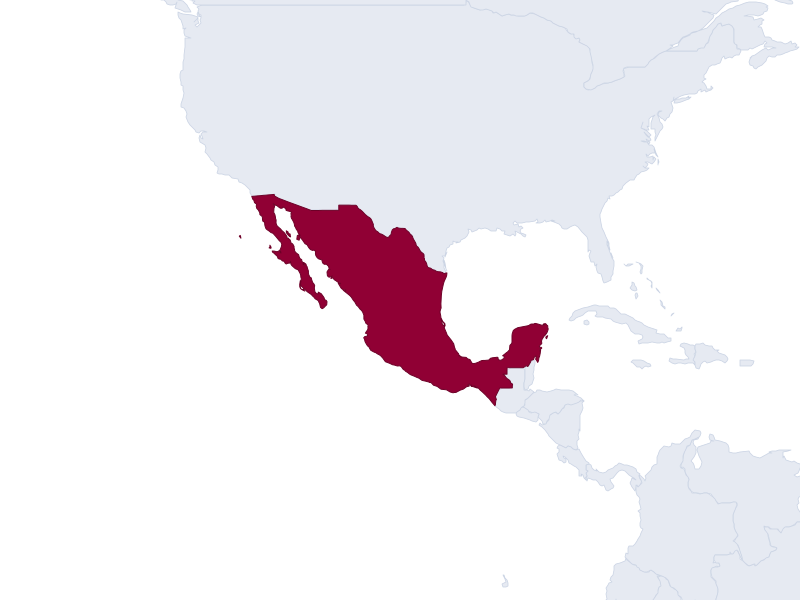
What a repatriation from Mexico costs
Mexico prices in the Long haul, 9 hours plus band. The range alongside is bed to bed and all in, covering the ground ambulance at both ends, the UK receiving bed and clinical handover, crew, equipment and oxygen, the seat block or stretcher, handling, landing and permits, the escort return travel and case management. Nothing here is a flight price with extras to follow.
£8,000to£75,000
From a medical escort in an economy seat to an air ambulance, bed to bed and all in.
Figures as at August 2026, from a blend of actual UCS Assist cases and supplier ranges. Ranges are wide because cases are not alike. The full bed-to-bed cost breakdown prices each mode of transport, sets out what moves a case up its band and shows how to sense-check a quote.
Common questions
Why does the payment position matter more here than in Europe?
Because there is no state alternative. In a European corridor a patient can be treated inside a public system while the commercial position is worked out. In Mexico care is private from the first minute, the hospital has no relationship with the insurer, and its own risk is entirely unmitigated until somebody confirms in writing who is paying. That is a rational position for the hospital to take, and it means an unanswered guarantee request does not simply delay the paperwork, it can stall the case while bed days accrue.
How should the guarantee of payment be handled?
Quickly, and scoped. Speed matters because the case does not progress without it. Scope matters because an open guarantee in a private market commits the insurer to a pathway nobody has seen, and the pathway will expand to fill it. A guarantee naming the condition, the episode of care and a review point achieves the same clinical outcome on the same timescale, and leaves a point at which somebody looks again.
What is different about a diving case?
The treatment happens before the transport decision does. Decompression illness needs recompression locally, and Cozumel and the Playa del Carmen area have chambers used to treating visiting divers. The repatriation question then arrives with a constraint attached, because a patient who has been treated for decompression illness needs a defined interval and a clinical assessment before flying, and the cabin altitude of a commercial aircraft is the whole reason. Getting the treating hyperbaric physician's view in writing is the step that most often gets missed.
A member had elective surgery in Mexico and is now unwell. Where does that leave us?
In a coverage conversation and a clinical one at the same time, and they need keeping apart. Complications of a privately arranged elective procedure are commonly excluded, while the acute emergency that presents may not be, and the member is unlikely to have understood the distinction when they booked. Clinically the priority is the same as any other case. Commercially the position needs establishing early, in writing, and communicated plainly, because the alternative is a dispute discovered at invoice stage.
Is a nine hour sector a problem for a stable patient?
It is a real consideration rather than a barrier. Nine hours changes total oxygen planning, raises thromboembolic risk in a patient who is already immobile, means managing any infusion across a full duty period, and gives one escort a long day with no realistic diversion for much of the route. A patient entirely fit to fly two hours from Malaga may need several more days of stabilisation before the same journey from Cancun is safe, and that judgement is the point of the assessment.
Does the hurricane season affect planning?
It affects scheduling rather than clinical decisions. Between June and November the Caribbean coast can lose airport capacity at short notice, and a plan built around a single scheduled departure is fragile. It is a reason to fix the receiving bed and the ground legs early and to hold an alternative routing, not a reason to move a patient before they are ready.
Other corridors
Managing a case in Mexico?
Our clinical and operational teams are available around the clock. If the case is live, call rather than email.