

Medical repatriation from Saudi Arabia
Most British cases in Saudi Arabia are pilgrims, not tourists or workers. That single fact sets the age, the season, the presentations and the difficulty of every part of the case.
6.5 to 7 hours from Jeddah or Riyadh
No reciprocal arrangement. Care is private for visitors and billed privately, though emergency treatment during pilgrimage seasons is often provided through dedicated arrangements
What we typically see from Saudi Arabia
- Cardiac events and strokes in elderly pilgrims during Hajj and Umrah, the largest and most demanding category
- Heat exhaustion and heat stroke, a serious and recurring risk when pilgrimage falls in the hottest months
- Falls, fractures and crush injury in dense crowd environments
- Deterioration of chronic disease in pilgrims who travelled while already unwell, sometimes against advice
- Respiratory infection spreading rapidly in mass gathering conditions
- Occupational and road injury among British workers on contracts in the Kingdom, a separate and year-round caseload
A pilgrimage corridor, not a tourist one
Almost every other corridor on this site describes leisure or business travel. Saudi Arabia describes something else, and the difference governs every case.
The great majority of British patients here are pilgrims performing Hajj or Umrah. Many are elderly. A significant proportion have known cardiac, respiratory or diabetic conditions. Some have travelled precisely because they wish to complete the pilgrimage while they are still able to, which means the population is, by selection, less well than a comparable group of holidaymakers.
They then undertake sustained physical exertion, frequently in extreme heat, in some of the densest crowd conditions anywhere in the world, a long way from their own doctor and their own records.
The predictable result is a concentration of cardiac events, strokes, heat illness, falls and respiratory infection in a fragile population, compressed into a short season. Planning this corridor as though it were Dubai misses everything that matters about it.
Scale is the operational problem
The medicine is not usually the hard part. The hospitals in Riyadh and Jeddah are well equipped and well staffed, and the Kingdom invests heavily in the medical infrastructure that supports the pilgrimage seasons.
The difficulty is finding your patient inside an event attended by millions, establishing which facility they were taken to, and reaching a clinician who can tell you what has been done. Movement around the holy sites is controlled. Communications are strained. Information that would take an hour to obtain in Malaga can take most of a day.
That is not a reason to expect less. It is a reason to start earlier, to be specific about what is being asked for, and to be realistic with families about timescales rather than promising an update by evening.
Heat as a diagnosis
On most corridors heat is context. Here it is a primary cause.
When the pilgrimage falls in the hottest months, heat exhaustion and heat stroke occur in numbers, and in an elderly population with cardiac and renal comorbidity they are dangerous rather than uncomfortable. Heat stroke in particular can leave consequences that persist well after the patient appears to have recovered, affecting renal function, coagulation and cognition.
That matters directly for fitness to fly. A patient who looks well on the ward two days after a serious heat illness may not be ready for a seven hour sector, and the assessment needs to be made on the trajectory and the bloods rather than on appearance.
Two corridors in one country
Running underneath the pilgrimage caseload is a year-round one that behaves completely differently: British workers on contracts, particularly in the Eastern Province.
Working-age patients, occupational and road injury, and a payer who is frequently an employer, a project policy or a contractual scheme rather than a travel insurer. As on the Germany corridor, the practical risk is a case where three possible payers each assume another is handling it, and the patient sits still while that gets resolved.
Establish who is issuing the guarantee of payment on day one. It is the fastest thing anyone can do to shorten the case.
Transport, and the season
Six and a half to seven hours from Jeddah or Riyadh is a manageable sector, and for a stable patient a commercial stretcher or a seated medical escort is both appropriate and far cheaper than a jet.
The complication is timing. During Hajj, scheduled capacity out of Jeddah is heavily committed and stretcher space is scarce at precisely the moment the caseload peaks. Booking early rather than optimistically is the practical lesson, and a plan that assumes a seat will be found tomorrow is a plan that will be revised.
Before the patient moves
Fitness to travel is assessed against the patient’s actual trajectory by a UK clinician who is accountable for it, and revisited if the picture changes. The UK receiving bed is secured before departure, matched to the consultant and the pathway rather than to the arrival airport. The clinical record reaches the receiving team ahead of the patient, and ground transfers at both ends are arranged and briefed.
Every decision is recorded in Atlas as it is made. For the general picture see medical repatriation and patient transport, and for the neighbouring corridor with a similar sector and a very different caseload, medical repatriation from the United Arab Emirates.
Where we stage from
The airport a case leaves from is a clinical decision as much as a logistical one, and it is set by where the patient is and what they can tolerate on the ground.
- Jeddah (JED): the gateway for Mecca and the overwhelming majority of pilgrimage cases
- Medina (MED): the second pilgrimage city, with its own seasonal caseload
- Riyadh (RUH): the capital, the deepest medical capability and the usual answer for a complex case
- Dammam (DMM): the Eastern Province and the contractor caseload
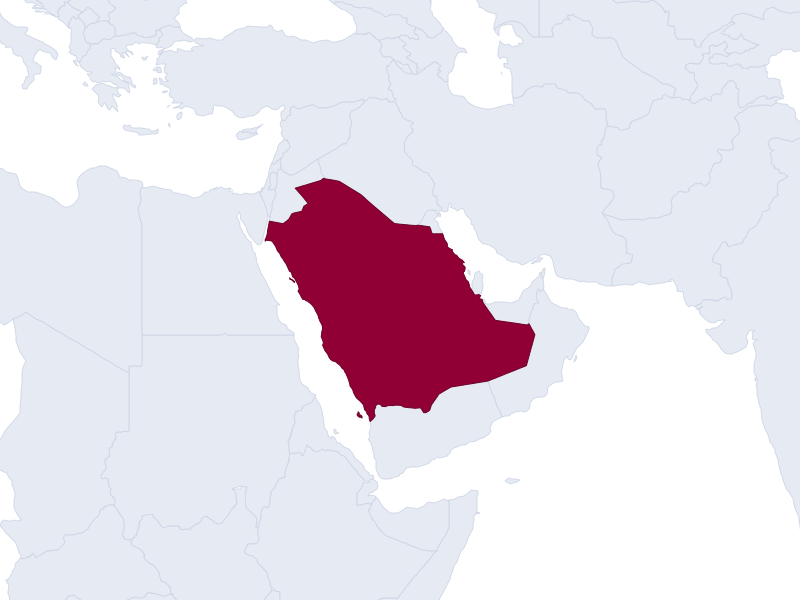
What a repatriation from Saudi Arabia costs
Saudi Arabia prices in the Medium haul, 5 to 8 hours band. The range alongside is bed to bed and all in, covering the ground ambulance at both ends, the UK receiving bed and clinical handover, crew, equipment and oxygen, the seat block or stretcher, handling, landing and permits, the escort return travel and case management. Nothing here is a flight price with extras to follow.
£5,000to£30,000
From a medical escort in an economy seat to an air ambulance, bed to bed and all in.
Figures as at August 2026, from a blend of actual UCS Assist cases and supplier ranges. Ranges are wide because cases are not alike. The full bed-to-bed cost breakdown prices each mode of transport, sets out what moves a case up its band and shows how to sense-check a quote.
Common questions
Why is the pilgrimage caseload so different?
Because of who travels and when. Many British pilgrims are elderly, a significant proportion have known cardiac, respiratory or diabetic conditions, and some travel specifically because they want to complete the pilgrimage while they still can. They then undertake sustained physical exertion, often in extreme heat, in extremely dense crowds, far from home. The result is a concentration of cardiac events, strokes, heat illness and falls in a population that is medically fragile to begin with.
What are the practical difficulties during Hajj?
Scale. Millions of people are present in a small area over a short period, and the medical response is organised around that. Locating an individual patient, identifying which facility they were taken to, and reaching a treating clinician all take longer than they would in ordinary circumstances. Movement around the holy sites is restricted and controlled. Flights out are heavily booked. None of it is insurmountable, and all of it needs allowing for rather than being met with surprise.
Is the hospital care good?
The major hospitals, particularly in Riyadh and Jeddah, are well equipped and well staffed, and Saudi Arabia invests heavily in the medical infrastructure supporting the pilgrimage seasons. The difficulty is rarely the standard of treatment. It is the logistics of the crowd, the pace at which information reaches an insurer, and getting a complete clinical record in a usable form.
How does heat change the clinical picture?
It is a primary cause rather than a background factor. When pilgrimage falls in the hottest months, heat exhaustion and heat stroke occur in significant numbers, and in an elderly population with cardiac and renal comorbidity they are genuinely dangerous. Heat stroke also has consequences that persist after the patient looks recovered, which is directly relevant to fitness to fly and is easy to underestimate on a seven hour sector.
What about the worker caseload?
It runs all year and behaves quite differently: working-age patients, occupational and road injury, and a payer who is frequently an employer or a project policy rather than a travel insurer. Establishing who is actually issuing the guarantee of payment matters as much here as in Germany, and for the same reason. A case with three possible payers, each assuming another is dealing with it, does not move.
How quickly can a repatriation be arranged?
Outside the pilgrimage seasons, typically two to three days once the patient is fit. During Hajj, longer, because scheduled capacity out of Jeddah is heavily committed and stretcher space is scarce at exactly the moment demand is highest. Booking early rather than optimistically is the practical lesson.
Other corridors
Managing a case in Saudi Arabia?
Our clinical and operational teams are available around the clock. If the case is live, call rather than email.