
Medical repatriation from Portugal
Portugal's caseload is older than its visitor numbers suggest. A large resident British population means more cardiac, stroke and fragility fracture, and fewer resort injuries, than the Algarve arrivals figures imply.
2.5 to 3 hours from Faro or Lisbon, 3.5 to 4 from Madeira
A UK GHIC covers state healthcare, though many visitors are taken to private hospitals where it does not apply
What we typically see from Portugal
- Cardiac events and strokes in the resident British retiree population across the Algarve and the Silver Coast
- Fragility fractures after falls, particularly fractured neck of femur, in older residents and visitors
- Golf-related musculoskeletal injury and cardiac events on the course, a genuinely distinctive feature of this corridor
- Deterioration of known chronic disease in long-stay winter residents
- Road traffic and scooter injuries in the summer resort season, at lower volume than Spain
- Surfing and watersports trauma along the Atlantic coast, including cervical spine injury
An older caseload than the arrivals figures suggest
Portugal reads, on paper, like a smaller Spain. In practice it behaves differently, because the population generating the cases is different.
A large settled British community lives along the Algarve and the Silver Coast, and it skews old. Add the long-stay winter visitors who arrive in October and leave in March, and a substantial share of the caseload is people in their seventies and eighties with real comorbidity, on multiple medications, a long way from the GP who knows their history.
The clinical consequences follow. Fewer moped injuries and alcohol-related trauma. More cardiac events, more strokes, more fractured necks of femur after a fall on a tiled floor, more decompensation of chronic disease that was stable at home.
That matters for the transport decision, because fitness to fly in a 79-year-old with atrial fibrillation, heart failure and a recent hip fracture is a genuine clinical question rather than a form to complete.
Two systems, and which one the patient landed in
Portugal has a functioning state system that a GHIC gives real access to, and a private sector that serves the resident and visiting foreign population. Many British patients in the Algarve end up in the private system by default, either because that is where the ambulance goes or because that is where they have always gone.
The care is generally good. The commercial position is entirely different: a GHIC has no standing, billing is private, and the incentive to admit and extend is the same as in any private market. Establishing which system the patient is in, in the first hours, changes what happens next.
Where the private setting is clinically appropriate, we manage the exposure through direct billing and clinical challenge on necessity. Where the state system is the better answer, that is a conversation worth having early.
The golf course
It is worth naming because it is genuinely distinctive to this corridor. The Algarve is one of Europe’s densest concentrations of golf courses, played predominantly by older visitors, often in heat, often several days running, frequently after a flight.
That produces a recognisable pattern: exertional cardiac events, heat-related illness, and musculoskeletal injury in people whose fitness has been overestimated by a fortnight of enthusiasm. Courses are also, by design, some distance from a road. The retrieval leg is longer than it looks.
The transport picture
Two and a half to three hours from Faro or Lisbon is a forgiving sector, well within commercial stretcher range, with reasonable scheduled capacity to UK regional airports as well as London.
For a stable patient a commercial stretcher or a seated medical escort is usually both the clinically appropriate and the substantially cheaper answer. A dedicated air ambulance is right for the ventilated or unstable patient, and for cases where minimising total transfer time is itself the clinical priority.
Madeira changes the arithmetic. The sector is an hour longer, capability on the island is good but finite, and the airport has operating characteristics in certain wind conditions that occasionally affect scheduling. Planning a Funchal case on mainland assumptions is how a straightforward repatriation becomes complicated.
Winter is the season that matters
Most people plan this corridor around summer arrivals. The clinically demanding months are the other ones.
Between October and March the Algarve’s British population is at its largest and its oldest, scheduled airline capacity is thinner, and the case mix is at its most medically complex. It is the period when a repatriation takes longest to arrange and needs the most clinical judgement, and it is the period least often planned for.
Before the patient moves
Fitness to travel is assessed against the patient’s actual trajectory by a UK clinician who is accountable for it, and revisited if the picture changes. The UK receiving bed is secured before departure, matched to the consultant and the pathway rather than to the arrival airport. The clinical record reaches the receiving team ahead of the patient, and ground transfers at both ends are arranged and briefed.
Every decision is recorded in Atlas as it is made. For the general picture see medical repatriation and patient transport, and for the corridor next door, medical repatriation from Spain.
Where we stage from
The airport a case leaves from is a clinical decision as much as a logistical one, and it is set by where the patient is and what they can tolerate on the ground.
- Faro (FAO): the Algarve catchment and the highest case volume in the country
- Lisbon (LIS): tertiary referral capability and the widest scheduled stretcher availability
- Porto (OPO): the north and the Silver Coast
- Funchal (FNC): Madeira, where the longer sector and the airport's own operating characteristics both matter
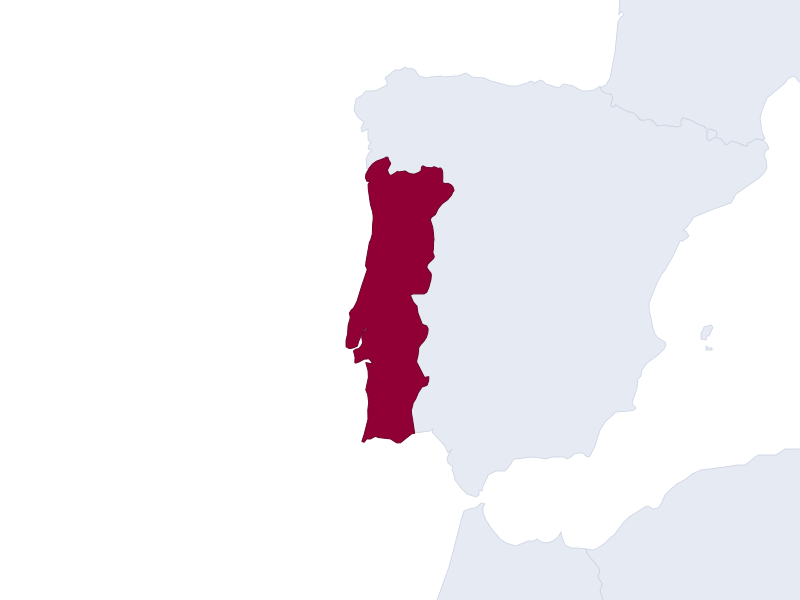
What a repatriation from Portugal costs
Portugal prices in the Europe, 2 to 4 hours band. The range alongside is bed to bed and all in, covering the ground ambulance at both ends, the UK receiving bed and clinical handover, crew, equipment and oxygen, the seat block or stretcher, handling, landing and permits, the escort return travel and case management. Nothing here is a flight price with extras to follow.
£3,000to£25,000
From a medical escort in an economy seat to an air ambulance, bed to bed and all in.
Figures as at August 2026, from a blend of actual UCS Assist cases and supplier ranges. Ranges are wide because cases are not alike. The full bed-to-bed cost breakdown prices each mode of transport, sets out what moves a case up its band and shows how to sense-check a quote.
Common questions
How does Portugal differ from Spain as a corridor?
The case mix is older and less traumatic. Portugal has a large settled British retiree population, particularly in the Algarve, so the presentations skew towards cardiac events, strokes and fragility fractures rather than the resort trauma that dominates the Spanish costas. Clinically that means more patients with significant comorbidity, more complex medication histories, and more cases where fitness to fly is a genuine question rather than a formality.
Will a GHIC cover treatment in Portugal?
For state healthcare, yes. The complication is that many British visitors and residents in the Algarve are taken to or choose private hospitals, where a GHIC has no standing at all. It also never covers repatriation. Establishing which system the patient is actually in, early, changes both the clinical and the commercial picture.
Is the local care good enough to treat rather than repatriate?
Frequently yes. Lisbon and Porto have genuine tertiary capability, and the private hospitals serving the Algarve are used to insured foreign patients. As elsewhere, the honest question is about the ongoing pathway rather than the acute care: where a patient faces weeks of rehabilitation or needs continuity with a UK consultant, bringing them home is right; where the definitive treatment can be completed well locally, it often should be.
What about Madeira?
Treat it as a separate corridor. The sector is an hour longer, the island has good but finite hospital capability at Funchal, and the airport has well-known operating characteristics in certain wind conditions that can affect scheduling. None of that is a problem if it is planned for. It is a problem if a mainland plan is applied to an island case.
How quickly can a repatriation be arranged?
Once the patient is genuinely fit to travel, usually within 24 to 48 hours. As on every short-haul corridor, the constraint is almost never the aircraft. It is clinical stability, obtaining the discharge summary and imaging, and securing an appropriate UK receiving bed.
Do you cover the winter, when the resorts are quiet?
Yes, and the winter caseload is one of the reasons this corridor is worth understanding properly. The Algarve's British population is at its largest between October and March, when long-stay residents and winter visitors are in the country. Scheduled capacity is thinner than in summer, so timescales are longer, and the case mix is at its most medically complex.
Other corridors
Managing a case in Portugal?
Our clinical and operational teams are available around the clock. If the case is live, call rather than email.