

Medical repatriation from Thailand
Thailand is the corridor where distance is the clinical problem. Eleven hours in the air is not a longer version of a Spanish flight; it is a different decision.
11 to 12 hours direct from Bangkok, plus the transfer to reach Bangkok
No. No reciprocal healthcare arrangement exists; treatment is chargeable from the outset
What we typically see from Thailand
- Motorcycle and scooter trauma, overwhelmingly the largest single category, frequently head and limb injuries in riders without helmets or licences
- Diving incidents including decompression illness, where flying is contraindicated until treated and cleared
- Road traffic collisions involving minibuses and songthaews on inter-province routes
- Sepsis and tropical infection, including dengue, presenting late in backpackers on the move
- Cardiac events and falls in the long-stay retiree population around Chiang Mai, Hua Hin and Pattaya
- Drowning and near-drowning, and alcohol-related trauma in the island resort economy
Distance is the clinical variable
Every repatriation corridor has one factor that dominates the planning. In Spain it is the sheer volume of routine cases. In the Gulf it is cost. In Thailand it is distance, and distance behaves differently from the way people expect.
An eleven-hour sector is not a longer version of a two-hour one. It changes:
- Oxygen planning, because the total requirement is five times greater and has to be carried.
- Thromboembolic risk, in a patient who may already be immobile and post-trauma.
- Infusion and drug management, over a period where a syringe driver will need changing more than once.
- Escort fatigue, on a crew who have already flown out and will be working a full duty period on the return.
- The margin for deterioration, because there is no diversion airfield with a UK-equivalent trauma unit over the Bay of Bengal.
A patient who is entirely fit for a Spanish sector may need several more days before a Thai one is safe. Assessing that against the patient’s trajectory rather than the pressure to move is the single most valuable clinical judgement on this corridor.
Motorbikes
The dominant case type in Thailand is scooter trauma, and it is dominant by a distance. Rented bikes, no helmet, frequently no licence, often alcohol, on roads with a mix of traffic that a UK rider has no experience of.
Clinically that means head injury, limb fractures, degloving and road rash with a high infection risk in a tropical climate. Commercially it means a coverage conversation about licensing and intoxication exclusions that needs to happen early, because it changes the case, and because a family being told about an exclusion in week three when they were not told in day one is a complaint waiting to happen.
Diving, and the case where flying is the danger
Thailand’s dive economy produces decompression illness cases, and they are the one category where the instinct to fly the patient home immediately is actively harmful. A patient with DCI needs recompression treatment and a defined interval afterwards before flight is safe. Flying too soon can cause permanent injury.
We set the flight window from the treating hyperbaric unit’s clinical picture. It is a good example of the general principle: the medicine sets the timing, not the aircraft.
The aircraft question is genuinely different here
From Europe, choosing an air ambulance is mostly a cost and acuity decision. From Thailand it is a range decision as well.
Most dedicated air ambulance aircraft cannot fly Bangkok to the UK in one leg. The options are a long-range jet, which is expensive and less widely available, or a mid-range aircraft with one or two technical fuel stops. Each stop adds ground time, a descent and climb cycle the patient has to tolerate, and crew duty constraints.
Against that, scheduled carriers out of Bangkok carry stretchers on a route with genuinely good capacity. For a stable patient the commercial stretcher with a properly equipped escort is very often both the clinically appropriate and the dramatically cheaper answer, and on this corridor the gap between the two options is measured in tens of thousands rather than thousands.
Sometimes the right answer is to treat, not to move
Bangkok and Phuket have private hospitals that are internationally accredited, genuinely capable and accustomed to working with insurers. That changes the question.
Where the ongoing pathway genuinely needs to be in the UK, meaning reconstruction, rehabilitation or continuity with an existing consultant, repatriation is right. Where the definitive treatment can be completed to a good standard locally, completing it and then flying a recovered patient home is safer for the patient and very substantially cheaper for the insurer. Making that call on clinical grounds rather than reflex is what cost containment through clinical challenge actually looks like in practice.
Islands add a leg, and the leg is the risk
A patient on Koh Samui, Koh Phangan, Koh Tao or Phi Phi is not simply further away. They are behind a transfer that has to be planned as clinical transport in its own right: boat or short sector to a facility with real capability, then onward staging. Samui’s runway limits which aircraft can operate there at all.
We coordinate that first leg rather than leaving it to whoever is available locally, because it is the point at which a case most often deteriorates unobserved.
What we do before the patient moves
The UK bed is secured before departure, matched to the specialty the patient needs. For a polytrauma case that is a specific trauma unit, not the nearest hospital to Heathrow. The clinical record, imaging and microbiology reach the receiving team ahead of the patient. Ground transfers at both ends are arranged and briefed.
Every decision is recorded in Atlas as it is made, with the clinician who made it. For the full picture see medical repatriation and patient transport and what good repatriation actually looks like.
Where we stage from
The airport a case leaves from is a clinical decision as much as a logistical one, and it is set by where the patient is and what they can tolerate on the ground.
- Bangkok Suvarnabhumi (BKK): tertiary hospitals, the widest airline stretcher capacity, and the realistic staging point for most cases
- Phuket (HKT): good private hospital capability and the main southern catchment, including transfers from Phi Phi and Krabi
- Koh Samui (USM): short runway with real aircraft limitations; most cases stage through Bangkok or Phuket
- Chiang Mai (CNX): northern Thailand and the long-stay retiree population
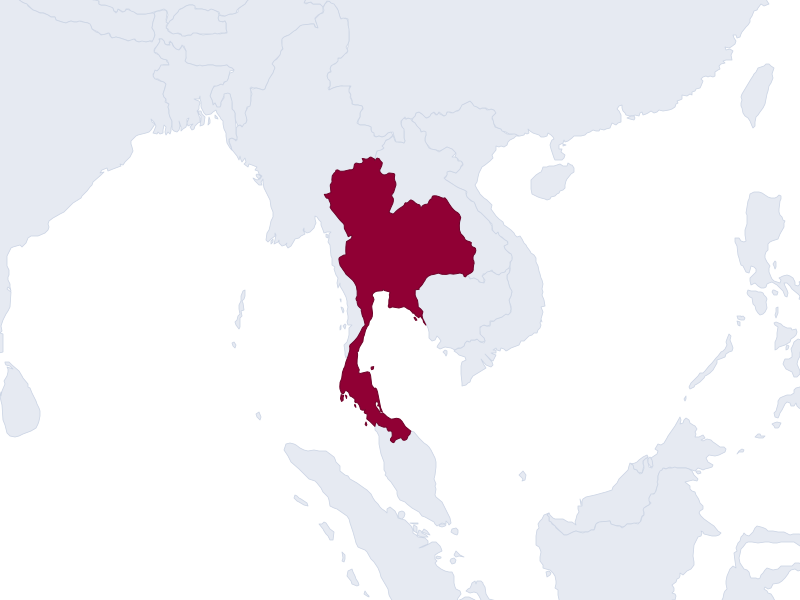
What a repatriation from Thailand costs
Thailand prices in the Long haul, 9 hours plus band. The range alongside is bed to bed and all in, covering the ground ambulance at both ends, the UK receiving bed and clinical handover, crew, equipment and oxygen, the seat block or stretcher, handling, landing and permits, the escort return travel and case management. Nothing here is a flight price with extras to follow.
£8,000to£75,000
From a medical escort in an economy seat to an air ambulance, bed to bed and all in.
Figures as at August 2026, from a blend of actual UCS Assist cases and supplier ranges. Ranges are wide because cases are not alike. The full bed-to-bed cost breakdown prices each mode of transport, sets out what moves a case up its band and shows how to sense-check a quote.
Common questions
Can a patient fly eleven hours safely?
Many can, and many cannot yet. The sector length is the clinical variable that dominates everything on this corridor. It changes oxygen requirements, pressure-related risk, immobility and thromboembolic risk, drug and infusion planning, and escort fatigue on a single crew. A patient who would be entirely fit for a two-hour Spanish sector may need several more days of stabilisation before an eleven-hour one is safe. That assessment is made against the patient's trajectory, not a form.
Why can't an air ambulance just fly straight to the UK?
Most dedicated air ambulance aircraft cannot make Thailand to the UK in a single leg. The realistic options are a long-range jet, or a mid-range aircraft with one or two technical fuel stops, each adding ground time, a descent and climb cycle, and crew duty considerations. That is a genuine clinical planning matter, not just a cost one, and it is why an air ambulance from Thailand is a materially bigger decision than one from Europe.
What happens with a diving injury?
Decompression illness is the case type where flying too early does direct harm. A patient needs recompression treatment and a clear post-treatment interval before flight is safe, and the interval is a clinical judgement rather than a fixed number. We coordinate with the treating hyperbaric unit and set the flight window from the clinical picture, not the other way round.
Is private hospital care in Thailand good enough to treat rather than move?
In Bangkok and Phuket, often yes. The major private hospitals are genuinely capable, internationally accredited and used to insurer relationships. That makes the honest question on this corridor not whether care is adequate but whether the patient's ongoing pathway is better served at home. Sometimes the clinically right answer is to complete treatment locally and repatriate a recovered patient, which is also far cheaper than moving a sick one.
How does island geography change things?
It adds a leg, and the added leg is where the risk is. A patient on Koh Samui, Koh Phangan or Phi Phi needs a transfer to a facility with real capability before anything else is decided. Samui's runway limits which aircraft can operate. That first leg has to be planned as clinical transport rather than treated as travel.
Who pays the hospital while this is being arranged?
Thai private hospitals generally require a guarantee of payment or a deposit before proceeding, and will chase it hard. We issue GOPs with defined scope at the point of need, so the member is treated without paying upfront and the insurer's exposure is scoped before treatment runs rather than after.
Other corridors
Managing a case in Thailand?
Our clinical and operational teams are available around the clock. If the case is live, call rather than email.