

Medical repatriation from Greece
Greece is not one corridor, it is a mainland and about two hundred inhabited islands. The island cases are the ones that need planning, and they are most of them.
3.5 to 4 hours from Athens; add the island leg, which is often the harder half
A UK GHIC covers state healthcare, but island facilities vary enormously and repatriation is never covered
What we typically see from Greece
- Falls and fractures on the stepped, uneven terrain of the island towns, disproportionately in older visitors
- Quad bike, scooter and ATV trauma, the signature island injury and often uninsured through licensing exclusions
- Cardiac events in the summer visitor population, frequently far from a cardiology-capable facility
- Heat-related illness and dehydration through July and August
- Boat, jetski and swimming incidents including near-drowning
- Deterioration of chronic disease in visitors staying on islands with limited pharmacy and diagnostic access
Two hundred islands and one mainland
Most repatriation corridors can be planned from the country. Greece cannot. A case in central Athens and a case on Mykonos are the same nationality and almost nothing else.
The mainland behaves like the rest of southern Europe: capable hospitals, a functioning GHIC relationship, a four-hour sector to the UK with reasonable scheduled capacity out of Athens and Thessaloniki. Straightforward.
The islands are where the work is, and the islands are where most of the visitors are.
The first leg is the hard one
A serious case on a smaller Greek island is typically at a health centre designed for primary care and stabilisation. No surgery, no intensive care, often no CT. The patient does not need a flight to the UK yet. They need to be somewhere with capability, and that is Athens, or Heraklion if they are in the south.
That first leg is a clinical transfer in its own right. Depending on the island, the weather, the hour and the patient it may be a helicopter, a fixed-wing air ambulance, or a coastguard asset. It is not a ferry with a relative in attendance, though that is what happens when nobody is coordinating it.
Getting this leg right is the single most valuable thing an assistance provider does on the Greek corridor, and it is the one most often left to whoever is available locally. We plan and escort it as part of a continuous transfer rather than as a local arrangement someone else makes.
Knowing which island has what
The variability is the whole problem. Crete has genuine tertiary capability at Heraklion. Rhodes and Corfu have functioning general hospitals that can manage a great deal. Kos, Zakynthos and Kefalonia have limited general capability. Santorini and Mykonos combine very high visitor volume with very limited medical capability, which is a difficult combination in August.
A plan built on the assumption that “there’s a hospital on the island” is not a plan. Establishing what the receiving facility can actually do, before committing a patient to it, is a clinical task and we treat it as one.
The seasonal cliff
Greek island logistics in July and in November are different problems wearing the same name.
Through the season there is dense scheduled capacity from every significant island, air ambulance assets are positioned nearby, and the hospitals are staffed for the surge. From late October, routes stop, aircraft reposition, and a case that would have been routine in August becomes a genuine planning exercise.
It is worth saying plainly because it affects timescales that get quoted to families. An out-of-season island case takes longer, and telling someone that honestly at the start is better than discovering it on day three.
Quad bikes, and the conversation to have early
The signature Greek island injury is the quad bike, closely followed by the scooter. Hire is casual, licence checks are rare, helmets are frequently absent, and the roads are not designed for inexperienced riders.
Clinically this produces head and limb trauma. Commercially it produces an exclusion conversation, because many policies will not respond where the member was not licensed for the vehicle. That needs establishing in the first hours, not the third week. Where cover does not respond, the member still needs safe clinical advice and a route home, and we will say so plainly rather than simply disengage.
The flight home
Once the patient is in Athens or Heraklion and stable, the sector to the UK is three and a half to four hours, well within commercial stretcher range, with reasonable capacity from Athens year-round.
For a stable patient, a stretcher or a seated medical escort on a scheduled service is usually the clinically appropriate and dramatically cheaper answer. A dedicated air ambulance is right for ventilated or unstable patients, and occasionally for the island leg where the alternative is an unacceptable delay.
We assess fitness to travel against the patient’s actual trajectory, secure an appropriate UK bed before departure, and make sure the clinical record reaches the receiving team ahead of the patient. Every decision is recorded in Atlas as it is made.
For the full picture see medical repatriation and patient transport, and what good repatriation actually looks like.
Where we stage from
The airport a case leaves from is a clinical decision as much as a logistical one, and it is set by where the patient is and what they can tolerate on the ground.
- Athens (ATH): the tertiary hub and the realistic staging point for most serious island cases
- Thessaloniki (SKG): northern Greece and the Halkidiki catchment
- Heraklion (HER) and Chania (CHQ): Crete, which has genuine hospital capability of its own
- Rhodes (RHO), Kos (KGS), Corfu (CFU), Zakynthos (ZTH): seasonal capacity, thin outside summer
- Mykonos (JMK) and Santorini (JTR): high visitor volume against very limited medical capability
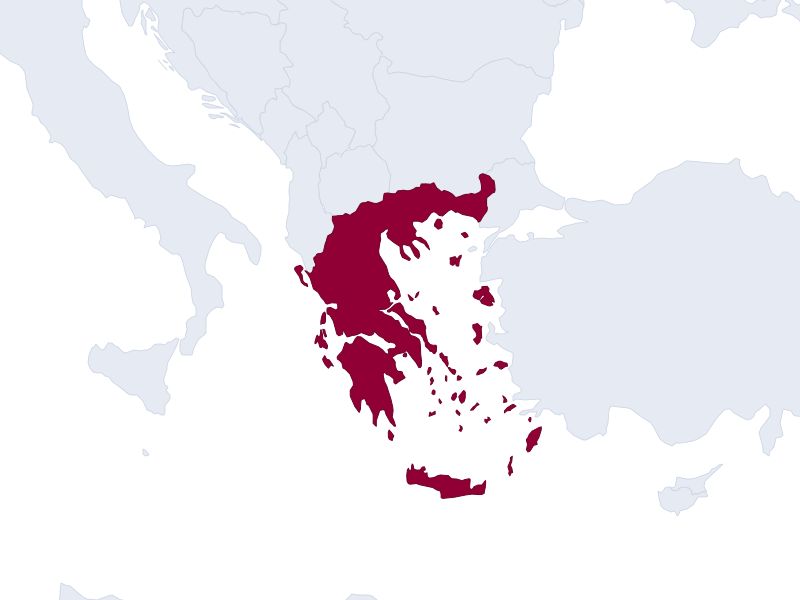
What a repatriation from Greece costs
Greece prices in the Europe, 2 to 4 hours band. The range alongside is bed to bed and all in, covering the ground ambulance at both ends, the UK receiving bed and clinical handover, crew, equipment and oxygen, the seat block or stretcher, handling, landing and permits, the escort return travel and case management. Nothing here is a flight price with extras to follow.
£3,000to£25,000
From a medical escort in an economy seat to an air ambulance, bed to bed and all in.
Figures as at August 2026, from a blend of actual UCS Assist cases and supplier ranges. Ranges are wide because cases are not alike. The full bed-to-bed cost breakdown prices each mode of transport, sets out what moves a case up its band and shows how to sense-check a quote.
Common questions
What makes the Greek islands different from mainland Europe?
The gap between where the patient is and where definitive care exists. A serious case on Santorini, Mykonos, Zakynthos or Kos is typically at a small health centre with basic capability. Before any question of repatriation to the UK arises, the patient usually needs moving to Athens or Crete, and that first leg is a clinical transfer requiring a helicopter, an air ambulance or a fixed-wing sector, not a taxi and a ferry.
How good are the island hospitals?
Enormously variable, and it matters more here than almost anywhere. Crete has real tertiary capability at Heraklion. Rhodes and Corfu have functioning general hospitals. Many smaller islands have a health centre staffed for primary care and stabilisation, with no surgery, no intensive care and no interventional cardiology. Knowing which is which before deciding anything is the difference between a well-run case and a dangerous one.
Does a GHIC cover me in Greece?
It covers state healthcare on the same basis as a Greek resident, which is genuinely useful on the mainland and in Crete. It does not cover repatriation, it does not cover private clinics, which is where many visitors are taken in the resort islands, and it does not cover the inter-island transfer that a serious case usually needs first.
Are quad bike and scooter injuries covered?
That is a policy question rather than a clinical one, and the answer is often no. Many travel policies exclude motorised vehicles the member was not licensed to ride, and quad and ATV hire on the islands rarely involves any licence check. It is worth establishing in the first hours, because it changes the entire shape of the case and a family told in week three what they should have been told on day one has a legitimate complaint.
What happens outside the summer season?
Everything thins out. Scheduled airline capacity to the islands collapses after October, some routes stop entirely, and both medical and air ambulance resources reduce. An October case from Zakynthos is a materially harder logistics problem than the identical case in July, and it needs planning as such rather than being assumed to be routine.
Can you arrange the transfer from the island as well as the flight home?
Yes, and it is the part we consider most important on this corridor. We coordinate the island-to-mainland leg as clinical transport with the appropriate escort and equipment, rather than treating it as travel to be arranged locally and hoping. Chain of clinical responsibility unbroken, bed to bed.
Other corridors
Managing a case in Greece?
Our clinical and operational teams are available around the clock. If the case is live, call rather than email.