

Medical repatriation from Cyprus
Cyprus is straightforward until it is not. A case in the south behaves like southern Europe. A case in the north raises questions about routing and documentation that no other Mediterranean corridor does.
4.5 to 5 hours from Larnaca or Paphos
A UK GHIC covers state healthcare in the Republic of Cyprus. It has no standing in the north
What we typically see from Cyprus
- Cardiac events and strokes in the large resident British retiree population, particularly around Paphos
- Falls and fragility fractures in older residents and long-stay visitors
- Road traffic and quad bike injuries in the Ayia Napa and Protaras resort corridor through the summer
- Heat-related illness and dehydration in the summer months, which are genuinely severe on the island
- Acute presentations in service families and personnel connected to the Sovereign Base Areas
- Watersports and swimming incidents along the south coast
Two situations, one island
For most of the caseload Cyprus behaves like a slightly further-away version of southern Europe. Capable hospitals, a large resident British population, a summer resort economy, a five-hour sector with reasonable scheduled capacity.
Then there is the north, and it is different enough to be worth understanding before a case arises rather than during one.
The Republic: a familiar pattern with an older population
The south generates the bulk of the volume, and the population generating it skews old. Paphos in particular has a large settled British community, and the case mix reflects it: cardiac events, strokes, falls and fragility fractures, and decompensation of chronic disease in people a long way from the GP who knows their history.
Alongside that sits a summer resort corridor around Ayia Napa and Protaras producing the familiar seasonal trauma, and a genuinely severe summer heat problem. Cyprus gets hot in a way that catches older visitors and outdoor workers out, and heat-related illness on this island is a real clinical category rather than a footnote.
Healthcare in the Republic is good. There are capable public hospitals, real tertiary capability in Nicosia, and a substantial private sector serving the resident foreign population. As anywhere a private sector serves insured foreigners, the question worth asking is not whether the care is adequate but whether the setting, the acuity and the length of stay were the appropriate ones, which is a clinical question requiring a clinician to answer.
The north: not a clinical problem, a logistical one
A case in the north is clinically the same job. The differences are routing and documentation, and they are enough to change timescales materially.
Flights from Ercan connect through Turkey rather than operating directly to the UK, which affects both scheduled stretcher options and how an air ambulance movement is planned. Moving a patient across to the south is possible but needs arranging properly rather than assumed. A GHIC has no standing in the north, so the funding position is different from the outset.
None of that is insurmountable. All of it is slow if it is discovered late. The practical answer is to establish, in the first hour, exactly where the patient is being treated and what the routing options actually are, before anybody quotes a timescale to a family.
The Sovereign Base Areas
Cases connected to Akrotiri and Dhekelia can involve their own medical arrangements and their own chain of clinical and financial responsibility. It is worth asking the question explicitly at the outset rather than assuming the civilian pathway applies, because discovering it halfway through a case creates confusion at exactly the wrong moment.
The transport picture
Four and a half to five hours is a middle-distance sector. Long enough that oxygen planning, immobility and infusion management genuinely matter and it should not be treated as a short hop. Short enough that for a stable patient a commercial stretcher or a seated medical escort on a scheduled service out of Larnaca is usually both the clinically appropriate and the far cheaper answer.
A dedicated air ambulance is right for the ventilated or unstable patient, and worth considering earlier for a northern case where the alternative routing would add a day.
Before the patient moves
Fitness to travel is assessed against the patient’s actual trajectory by a UK clinician who is accountable for it. The UK receiving bed is secured before departure, matched to the consultant and the pathway rather than to the arrival airport. The clinical record reaches the receiving team ahead of the patient, and ground transfers at both ends are arranged and briefed.
Every decision is recorded in Atlas as it is made. For the general picture see medical repatriation and patient transport, and for the corridor with the most in common, medical repatriation from Greece.
Where we stage from
The airport a case leaves from is a clinical decision as much as a logistical one, and it is set by where the patient is and what they can tolerate on the ground.
- Larnaca (LCA): the main international gateway, with the widest scheduled stretcher availability
- Paphos (PFO): the western catchment and the largest resident British population
- Ercan (ECN): serves the north, with routing implications that need establishing before anything is booked
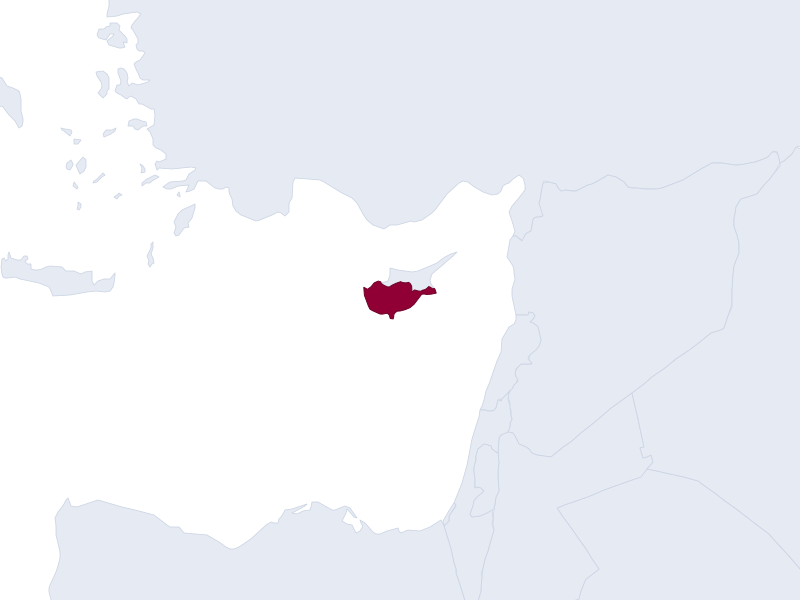
What a repatriation from Cyprus costs
Cyprus prices in the Medium haul, 5 to 8 hours band. The range alongside is bed to bed and all in, covering the ground ambulance at both ends, the UK receiving bed and clinical handover, crew, equipment and oxygen, the seat block or stretcher, handling, landing and permits, the escort return travel and case management. Nothing here is a flight price with extras to follow.
£5,000to£30,000
From a medical escort in an economy seat to an air ambulance, bed to bed and all in.
At 4.5 to 5 hours Cyprus sits at the bottom of this band.
Figures as at August 2026, from a blend of actual UCS Assist cases and supplier ranges. Ranges are wide because cases are not alike. The full bed-to-bed cost breakdown prices each mode of transport, sets out what moves a case up its band and shows how to sense-check a quote.
Common questions
Does a GHIC work in Cyprus?
In the Republic of Cyprus, yes, for state healthcare. In the north it has no standing at all, and neither does an EHIC. That distinction catches people out regularly, because a member does not always know which side of the line they are being treated on, and the answer changes both the funding position and the practical options.
What is different about a case in the north?
Routing and documentation. Flights from Ercan connect through Turkey rather than operating directly to the UK, which affects both scheduled stretcher options and how an air ambulance movement is planned. Transfers across the line to the south are possible but need arranging properly rather than assumed. The clinical work is the same; the logistics and the paperwork are not, and getting them wrong costs days.
How good is the healthcare?
In the Republic, good. There are capable public hospitals and a substantial private sector serving the resident foreign population, and Nicosia has real tertiary capability. As everywhere with a large private sector serving insured foreign patients, the question worth asking is not whether the care is adequate but whether the setting and the length of stay were the appropriate ones.
Is Cyprus close enough for a commercial stretcher?
Usually yes. Four and a half to five hours is a middle-distance sector, comfortably within stretcher range on scheduled services from Larnaca, with reasonable capacity through the season. It is long enough that oxygen planning and immobility genuinely matter, so it should not be treated as a short hop, but it rarely justifies a dedicated aircraft for a stable patient.
What about the Sovereign Base Areas?
Cases connected to the SBAs at Akrotiri and Dhekelia can involve their own medical arrangements and their own chain of responsibility. Establishing early who is clinically responsible and who is funding avoids a great deal of confusion later, and it is worth asking the question explicitly rather than assuming the civilian pathway applies.
How quickly can it be arranged?
From the south, usually 24 to 48 hours once the patient is genuinely fit to travel. From the north, allow longer, because the routing and documentation questions have to be resolved before anything can be booked and they cannot be rushed at the last minute.
Other corridors
Managing a case in Cyprus?
Our clinical and operational teams are available around the clock. If the case is live, call rather than email.