

Medical repatriation from Tunisia
Tunisia is a three hour package destination with a private clinic sector built for European visitors and a hospital system that most insured patients never see. Which one the patient lands in decides the case.
3 to 3.5 hours from Enfidha, Monastir, Tunis or Djerba, with charter capacity concentrated in season
No reciprocal arrangement. Insured visitors are treated in private clinics and billed privately, with payment confirmation expected before treatment progresses
What we typically see from Tunisia
- Cardiac events and strokes in older package visitors, particularly on all-inclusive winter stays
- Road traffic and excursion injury, including quad bike and desert tour incidents
- Watersports and beach injury along the Hammamet and Sousse coast
- Severe gastrointestinal illness and dehydration requiring admission
- Fractures after falls in resorts and on excursions, in a visitor population that skews older
- Complications of privately arranged cosmetic and dental treatment, on a growing medical tourism corridor
A short sector and a private market
Tunisia sits three to three and a half hours from the UK and sells a mainstream package holiday, largely to an older visitor profile on all-inclusive stays. That combination produces a caseload weighted more towards medical presentations than trauma: cardiac events, strokes, falls and gastrointestinal illness rather than the moped injuries that dominate a younger destination.
For an insured visitor, care happens in the private clinic sector. There is no reciprocal arrangement, the public system is not where these patients complete a pathway, and billing is private from the first minute.
The private clinics in Tunis and the main resort areas are French-influenced in training and practice, familiar in their clinical framework, and used to European patients and international insurers. That makes them relatively straightforward to work with, and it does not remove the need for the usual disciplines.
Fast and scoped, again
A clinic with an admitted foreign patient and no confirmed payer carries an entirely unhedged risk, so it wants the payment position settled early and as broadly as it can get it. That is rational rather than opportunistic, and it produces the same two failure modes as every private corridor.
A slow guarantee of payment stalls the case while bed days accrue. An unscoped one is read as an authorisation, and the pathway expands to fill it.
Fast enough that nothing stops, scoped to the condition, the episode and a review point. The reasoning is set out in who actually pays, and when, and it applies here exactly as it does in Morocco and Egypt.
Where capability stops
The better clinics handle the great majority of what this corridor produces. For major neurotrauma, complex cardiac intervention, or intensive care sustained over a long period, capability narrows.
Recognising that early is the skill. The failure mode on every corridor with a capability ceiling is the same: a patient held in a facility that is managing rather than treating, while days pass and everyone hopes for improvement. On a three hour sector, moving a patient who needs more is straightforward and cheap, which makes the delay harder to justify than it would be from Bali.
The elective surgery caseload
Tunisia has a growing market in privately arranged cosmetic and dental treatment aimed at European patients, and a proportion of those patients become unwell afterwards.
This is the familiar awkward category. The elective procedure is usually excluded, the complication presents as an emergency and may not be, and the member almost never understood that these are treated differently. Establish what was done, where and when; establish what is being treated now; keep the coverage conversation separate from the clinical response; and give the member a plain answer early rather than a dispute at invoice stage. The same pattern is set out on the Poland corridor.
Season decides the routing
Capacity to the UK is charter-driven, which means it follows the package season closely.
In summer there are direct options from Enfidha and Monastir. In a quiet month a patient who is entirely fit to fly direct may still be routed via Tunis and a European hub, adding a sector, a handover and a day. Check what actually flies before promising a family a date.
Before the patient moves
Fitness to travel is assessed against the patient’s actual trajectory by a UK clinician who is accountable for it, and revisited if the picture changes. The UK receiving bed is secured before departure, matched to the consultant and the pathway rather than to the arrival airport. The clinical record reaches the receiving team ahead of the patient, and ground transfers at both ends are arranged and briefed.
Every decision is recorded in Atlas as it is made. For the general picture see medical repatriation and patient transport, and for the neighbouring corridor with a similar market and a similar caseload, medical repatriation from Morocco.
Where we stage from
The airport a case leaves from is a clinical decision as much as a logistical one, and it is set by where the patient is and what they can tolerate on the ground.
- Enfidha (NBE) and Monastir (MIR): the main resort catchment and the bulk of charter capacity
- Tunis (TUN): the capital, the deepest medical capability and the best year-round scheduled options
- Djerba (DJE): the island, with its own seasonal charter pattern and a longer transfer to Tunis
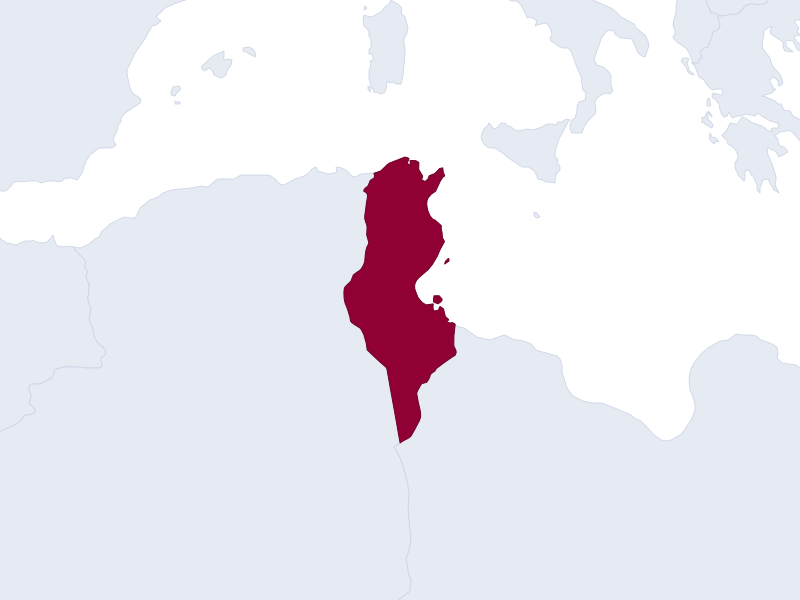
What a repatriation from Tunisia costs
Tunisia prices in the Europe, 2 to 4 hours band. The range alongside is bed to bed and all in, covering the ground ambulance at both ends, the UK receiving bed and clinical handover, crew, equipment and oxygen, the seat block or stretcher, handling, landing and permits, the escort return travel and case management. Nothing here is a flight price with extras to follow.
£3,000to£25,000
From a medical escort in an economy seat to an air ambulance, bed to bed and all in.
Figures as at August 2026, from a blend of actual UCS Assist cases and supplier ranges. Ranges are wide because cases are not alike. The full bed-to-bed cost breakdown prices each mode of transport, sets out what moves a case up its band and shows how to sense-check a quote.
Common questions
Where are insured visitors actually treated?
In the private clinic sector, which in Tunis, Sousse and Hammamet is oriented towards European patients, French-influenced in training and practice, and used to dealing with international insurers. The public system exists and will treat an emergency but is not where an insured visitor completes a pathway. Establishing which facility the patient has been taken to, and what it can actually do, is the first call rather than the third.
How good is the private care?
In the better clinics in Tunis and the main resort areas, competent for the great majority of what this corridor produces, with clinicians frequently trained in France and a familiar clinical framework. The limit is depth. For major neurotrauma, complex cardiac intervention or sustained intensive care, capability narrows, and a case that exceeds it needs recognising quickly rather than after several days.
How should the payment position be handled?
Early, in writing and scoped. There is no reciprocal arrangement, care is private throughout, and the clinic has no relationship with the payer. A confirmed guarantee is what keeps the case moving; an unscoped one commits the insurer to a pathway that will expand to fill it. This is the same pattern as Morocco and Egypt and it matters for the same reasons.
Does the medical tourism caseload cause problems?
Increasingly, yes. Tunisia has a growing market in privately arranged cosmetic and dental work aimed at European patients, and complications present afterwards as emergencies. The elective procedure is commonly excluded while the acute problem may not be, and the member rarely understood the distinction. Establish the position early and in writing, keep it separate from the clinical response, and give the member a plain answer rather than a deferred one.
What happens out of season?
Transport becomes the constraint. Capacity to the UK is charter-driven and concentrated in the summer season, so a case in a quiet month may need routing via Tunis and a European hub, adding a sector and usually a day. It is worth checking what actually flies before committing to a date with a family.
How quickly can a repatriation be arranged?
In season, usually within 48 hours of the patient being fit to travel. Out of season, longer and less directly. Obtaining a complete clinical record, particularly imaging rather than a report, takes more chasing than on a European corridor and should be started on day one.
Other corridors
Managing a case in Tunisia?
Our clinical and operational teams are available around the clock. If the case is live, call rather than email.