

Medical repatriation from Jamaica
Jamaica generates more cases in people visiting family than in tourists, which changes the age, the comorbidity and the insurance position of almost every patient on this corridor.
9 to 10 hours direct from Montego Bay or Kingston
No reciprocal arrangement. The public system will treat an emergency, but insured visitors are generally managed privately and billed privately
What we typically see from Jamaica
- Cardiac events and strokes in older British visitors staying with family, the largest single category
- Deterioration of chronic disease, particularly diabetes, hypertension and sickle cell related presentations
- Road traffic trauma on rural routes, sometimes with a long transfer to a capable hospital
- Resort and watersports injury on the north coast, at lower volume than the visiting-family caseload
- Falls and fragility fractures in elderly visitors on extended stays
- Cases where the patient has been in Jamaica for months and the boundary between visitor and resident is genuinely unclear
Not a resort corridor
Jamaica looks on paper like the Caribbean beach destinations, and it does not behave like them.
The dominant caseload is British visitors staying with family, often for weeks or months, and that changes almost everything about a case. The patient is older. They are more likely to have significant comorbidity, a long medication list, and a chronic condition that was stable at home and is now not. They are frequently deep into an extended stay rather than three days into a fortnight.
They are also considerably more likely to have no travel policy at all, or one that quietly expired part way through the trip. That is a conversation to have early, gently, and in writing, because it decides what is possible.
The clinical consequence is a case mix weighted towards cardiac events, strokes, diabetic emergencies and decompensation rather than the trauma that dominates a resort corridor. The transfer decision usually turns on the rehabilitation pathway rather than on an acute injury.
Capability, and where it stops
The private hospitals in Kingston and Montego Bay handle a great deal competently and are accustomed to insured foreign patients. The public system carries a heavy load with variable resources.
The real constraint is depth rather than quality. For complex neurosurgery, some cardiac intervention, and intensive care sustained over a long period, capability on the island is finite. Recognising that early is the skill, because the alternative is a patient held in a facility that is managing rather than treating while everyone hopes they improve.
Miami, and the trap in it
When local capability runs out, Miami is ninety minutes away with capability equivalent to anywhere in the world. That is a genuine and valuable option.
It also carries a specific commercial warning. A United States admission operates at a price level that dwarfs the Jamaican account, and it can escalate very quickly. The move needs its own scoped guarantee of payment, issued deliberately, rather than an extension of the existing one waved through at two in the morning because the transfer is already booked.
Used for the right reason, it saves a patient. Used as a reflex when a Jamaican hospital is in fact managing the case properly, it converts a moderate claim into a very large one and buys nothing clinically. The disciplines that apply on arrival are the ones set out on the United States corridor.
The extended stay question
Enough of this corridor’s patients have been in the country for months that it needs a settled approach rather than an improvisation each time.
Long stays blur the boundary between visitor and resident, and with it several things that matter: which policy applies, whether it lapsed, what the patient may be entitled to locally, and who the insurer’s counterparty actually is. Establishing the dates on day two, from a family who almost always know them, is straightforward. Establishing them at claim stage, after the money has moved, is not.
Before the patient moves
Fitness to travel is assessed against the patient’s actual trajectory by a UK clinician who is accountable for it, and revisited if the picture changes. The UK receiving bed is secured before departure, matched to the consultant and the pathway rather than to the arrival airport. The clinical record reaches the receiving team ahead of the patient, and ground transfers at both ends are arranged and briefed.
Every decision is recorded in Atlas as it is made. For the general picture see medical repatriation and patient transport, and for the neighbouring Caribbean corridor with a different visitor profile, medical repatriation from Barbados.
Where we stage from
The airport a case leaves from is a clinical decision as much as a logistical one, and it is set by where the patient is and what they can tolerate on the ground.
- Montego Bay (MBJ): the widest scheduled capacity to the UK and the north coast catchment
- Kingston (KIN): the capital, the deepest hospital capability and the eastern half of the island
- Miami (MIA): the regional escalation option where local capability is exceeded, roughly ninety minutes away
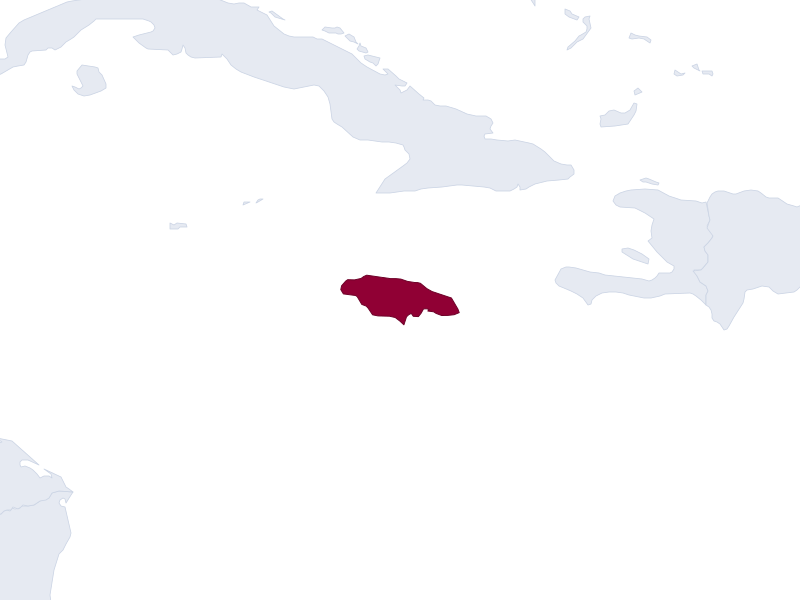
What a repatriation from Jamaica costs
Jamaica prices in the Long haul, 9 hours plus band. The range alongside is bed to bed and all in, covering the ground ambulance at both ends, the UK receiving bed and clinical handover, crew, equipment and oxygen, the seat block or stretcher, handling, landing and permits, the escort return travel and case management. Nothing here is a flight price with extras to follow.
£8,000to£75,000
From a medical escort in an economy seat to an air ambulance, bed to bed and all in.
Figures as at August 2026, from a blend of actual UCS Assist cases and supplier ranges. Ranges are wide because cases are not alike. The full bed-to-bed cost breakdown prices each mode of transport, sets out what moves a case up its band and shows how to sense-check a quote.
Common questions
Why does the visiting-family pattern matter so much?
Because it changes the patient. This corridor carries a large number of older British visitors staying with relatives for weeks or months rather than a fortnight in a resort. They are more comorbid, on longer medication lists, further into a stay, and considerably more likely to have no travel insurance at all or a policy that lapsed part way through an extended trip. The clinical presentations skew heavily towards cardiac events, strokes and decompensation rather than trauma.
Is the local hospital care adequate?
The private hospitals in Kingston and Montego Bay manage a great deal competently and are used to insured foreign patients. The public system carries a heavy load and is variable. The genuine limit is depth: for complex neurosurgery, some cardiac intervention and sustained intensive care, capability on the island is finite, and the honest answer in those cases is a regional move rather than waiting.
Where do patients go when local capability runs out?
Miami, which is roughly ninety minutes away and has capability equivalent to anywhere. That is a genuinely useful option and it carries a warning attached: a United States admission is expensive on a scale that dwarfs the Jamaican account, and it needs its own scoped guarantee of payment rather than an extension waved through under pressure. It is the right move when the patient needs capability the island cannot provide. It is an expensive reflex otherwise.
What about a patient who has been on the island for months?
This comes up often enough to need a settled approach. Extended stays blur the line between visitor and resident, and with it the questions of which policy applies, whether it lapsed, and whether the patient is entitled to anything locally. Establish the dates early and in writing. It is a much easier conversation on day two than at claim stage, and the family will usually have the answers if somebody asks.
How should the payment position be handled?
Early and scoped. There is no reciprocal arrangement, insured visitors are managed privately, and hospitals have no relationship with the payer. Where a Miami transfer is in prospect the guarantee must anticipate it explicitly as a separate account in a separate country, at a very different price level.
How quickly can a repatriation be arranged?
Once the patient is fit to travel, usually two to three days. Direct scheduled capacity from Montego Bay to the UK is reasonable and stretcher space needs booking rather than assuming. Where the patient is in Kingston, the domestic leg is straightforward but should still be planned rather than assumed.
Other corridors
Managing a case in Jamaica?
Our clinical and operational teams are available around the clock. If the case is live, call rather than email.