

Medical repatriation from the UAE
The UAE has hospitals as good as anything in Europe. That makes the question not whether the care is adequate, but why the bill is what it is and whether the patient should be moved at all.
7 to 7.5 hours direct from Dubai or Abu Dhabi
No reciprocal arrangement. Care is private, chargeable and expensive from the outset
What we typically see from United Arab Emirates
- Road traffic trauma, including high-speed collisions on the inter-emirate highways
- Workplace and construction injuries, including falls from height and crush injuries
- Cardiac events in the long-stay expatriate professional population
- Watersports, desert driving and quad bike injuries in the visitor market
- Acute presentations in expatriates whose local cover ends with their employment
- Heat-related illness through the summer months, in visitors and outdoor workers
A corridor where the clinical question and the cost question are different questions
Most repatriation corridors present a version of the same problem: the local care is variable, so getting the patient to a better standard is the driver. The UAE is not that.
Dubai and Abu Dhabi have hospitals with intensive care, neurosurgery, cardiothoracic and trauma capability that stand comparison with anywhere in Europe. Nobody needs repatriating from the UAE because the medicine is inadequate.
What the UAE presents instead is a high-tariff private market where the volume of care delivered is rarely challenged, and an expatriate population whose funding position can change overnight. Those are the two things worth being good at on this corridor.
Why repatriate, and when not to
The instinct when a bill starts climbing is to move the patient. On this corridor that instinct is frequently wrong, and expensive in its own right.
Moving an acutely unwell patient carries clinical risk, requires an escort and often an aircraft, and once the full transfer cost is counted the saving against a few more days of local care is often smaller than it looked. It can also interrupt a treatment episode at exactly the wrong point.
The defensible reasons to repatriate from the UAE are about the ongoing pathway, not the acute care:
- The patient needs rehabilitation that will run for weeks or months, which is far better delivered at home.
- They need reconstruction or staged surgery with continuity from a single UK team.
- They have an existing UK consultant relationship and a condition that belongs back in it.
- They are medically stable and no longer need acute care, at which point every further day in a private bed is spend without clinical purpose.
That last one is the common case, and the one that gets missed because nobody is actively driving the discharge.
Containing cost where the care is genuinely good
If the medicine is sound, cost containment cannot be about questioning quality. It has to be about the volume and the setting, and that requires someone clinically qualified to read the record alongside the bill.
The recurring patterns on this corridor are the familiar ones, amplified by the tariff:
- Intensive care beds retained after the clinical need for that level of care has passed.
- Length of stay that lags the patient’s actual trajectory, because no one is pressing for step-down.
- Repeat imaging on transfer between facilities, because the prior study was never requested.
- Incidental findings investigated in full during an acute episode for something unrelated.
None of these appear on an invoice as avoidable. They are visible only to a clinician reading the notes in something close to real time, which is the whole argument behind cost containment through clinical challenge rather than discount negotiation.
The expatriate cover cliff
A recurring and genuinely difficult situation: a UK national working in the UAE has medical cover provided through their employer. The employment ends. The cover ends with it, sometimes immediately, sometimes with a notice period nobody read.
An acute presentation shortly afterwards puts them in a private system with no funding, in a country where hospitals require a guarantee before proceeding beyond stabilisation, and where the consular route is slow and limited. The window in which the situation can be managed well is short.
Where this arises we establish the funding position immediately and say plainly what is and is not covered, because the worst outcome is a family who believe they are covered for three weeks and then discover they are not.
Guarantees of payment, issued with scope
UAE private hospitals will require a GOP or a deposit. Issuing one is not just an access step, it is a control point. A guarantee with defined scope establishes what is authorised before treatment begins, and requires a fresh decision for anything beyond it. Issued open-ended, it is a blank cheque in a market that will use it.
The transport picture
Seven hours is long enough to matter clinically, for oxygen planning, immobility, infusion management and escort duty, but Dubai and Abu Dhabi have some of the best scheduled connectivity to the UK anywhere in the world, and the airlines on these routes handle stretchers routinely.
For a stable patient, a commercial stretcher with a properly equipped clinical escort is usually the right answer and a fraction of the cost of a dedicated aircraft. Air ambulance is for ventilated or unstable patients, and for cases where minimising total transfer time is itself the clinical priority.
Formalities that cannot be left to the last day
Road traffic collisions, workplace injuries and deaths in the UAE can involve police processes, employer procedures and documentation that must be completed before a patient or their remains can leave the country. Discovering that at the airport is a bad day for everyone.
We start those in parallel with the clinical coordination, secure the UK receiving bed before departure, and record every decision in Atlas as it is made. For the full picture see medical repatriation and patient transport, and for how the same clinical logic applies to a caseload rather than a case, complex case management.
Where we stage from
The airport a case leaves from is a clinical decision as much as a logistical one, and it is set by where the patient is and what they can tolerate on the ground.
- Dubai International (DXB): widest airline stretcher availability anywhere in the region
- Abu Dhabi Zayed International (AUH): tertiary capability and good scheduled capacity
- Sharjah (SHJ) and Ras Al Khaimah (RKT): used where the treating facility catchment makes it the shorter ground leg
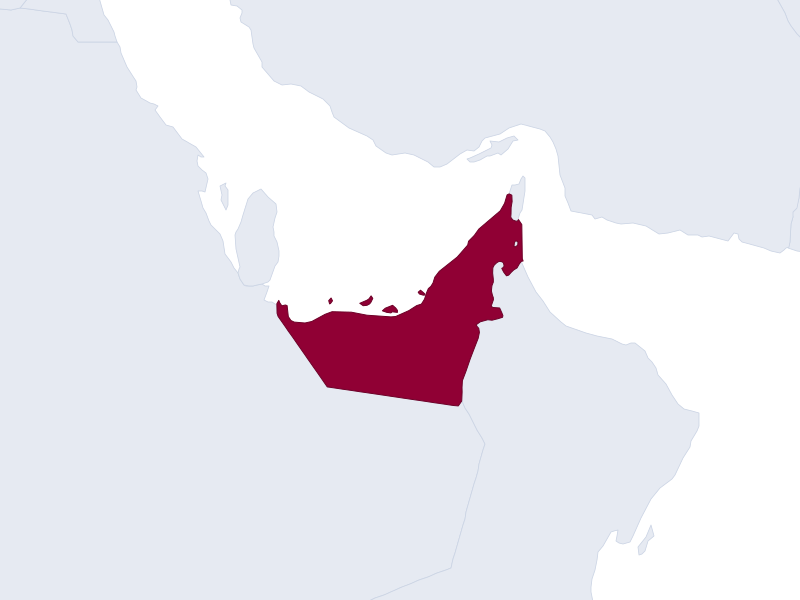
What a repatriation from United Arab Emirates costs
United Arab Emirates prices in the Medium haul, 5 to 8 hours band. The range alongside is bed to bed and all in, covering the ground ambulance at both ends, the UK receiving bed and clinical handover, crew, equipment and oxygen, the seat block or stretcher, handling, landing and permits, the escort return travel and case management. Nothing here is a flight price with extras to follow.
£5,000to£30,000
From a medical escort in an economy seat to an air ambulance, bed to bed and all in.
Figures as at August 2026, from a blend of actual UCS Assist cases and supplier ranges. Ranges are wide because cases are not alike. The full bed-to-bed cost breakdown prices each mode of transport, sets out what moves a case up its band and shows how to sense-check a quote.
Common questions
The care is excellent. Why repatriate at all?
Often you should not, at least not immediately. UAE tertiary hospitals are genuinely world-class, so the honest question is about the ongoing pathway rather than the acute care. Repatriate when the patient needs rehabilitation, reconstruction, or continuity with a UK consultant and a UK care package. Do not repatriate a patient mid-acute-episode simply because the daily rate is uncomfortable. Moving a sick patient is both riskier and, once the transfer cost is counted, frequently not the saving it appears to be.
Why are UAE medical bills so high?
It is a private, tariff-driven market with high facility costs and a strong commercial incentive to admit, investigate and extend. Nothing about that is improper, but it means the volume of care delivered is rarely challenged unless somebody clinically qualified challenges it. That is where the containable cost sits: the setting, the length of stay, the repeat imaging, the intensive care bed retained after the clinical need for it has passed.
What happens when an expatriate's cover ends with their job?
It is one of the most common difficult situations on this corridor. Employer-provided cover frequently terminates with employment, sometimes with very little notice, and an acute presentation shortly afterwards leaves a UK national in a private system with no funding and a hospital that will require a guarantee before proceeding. The position needs establishing immediately, because the options narrow fast and the consular route is slow.
Will a guarantee of payment be required before treatment?
Almost always. UAE private hospitals typically require a GOP or a deposit before proceeding with anything beyond immediate stabilisation. We issue guarantees with defined scope at the point of need, which does two things: the member is treated without paying upfront, and what is authorised is established before treatment begins rather than argued about after it concludes.
Stretcher or air ambulance on a seven-hour sector?
Seven hours is long enough that the sector matters clinically, but Dubai and Abu Dhabi have exceptional scheduled connectivity to the UK and airlines on these routes carry stretchers regularly. For a stable patient, a commercial stretcher with a properly equipped escort is usually both appropriate and very substantially cheaper. Air ambulance is right for ventilated or unstable patients, and where total transfer time is itself the clinical priority.
Can you deal with the documentation and exit requirements?
Yes. Cases involving road traffic collisions, workplace injuries or a death can involve police reports, employer processes and formalities that must be completed before a patient or their remains can leave. These are best started immediately rather than discovered at the airport, and we handle them alongside the clinical coordination.
Other corridors
Managing a case in United Arab Emirates?
Our clinical and operational teams are available around the clock. If the case is live, call rather than email.