

Medical repatriation from Morocco
Morocco is three and a half hours from London and a long way from a British hospital in every other sense. The flight is short, which is fortunate, because almost everything that precedes it takes longer than people expect.
3.5 to 4 hours from Marrakech or Agadir, slightly less from Tangier and the north
No reciprocal arrangement. A GHIC has no standing, the public system is not where insured visitors are treated, and private clinics expect the payment position confirmed early
What we typically see from Morocco
- Road traffic trauma, including long transfers from the mountain passes and the routes between cities
- Quad bike, camel and horse riding injury on excursions, a recurring and distinctly local pattern
- Trekking and altitude related illness in the High Atlas, where retrieval can take a day rather than an hour
- Cardiac events in older visitors, often exacerbated by heat and by exertion on excursions
- Severe gastrointestinal illness and dehydration requiring admission, particularly in patients with existing comorbidity
- Surf and watersports trauma along the Atlantic coast around Taghazout and Essaouira
A short flight and a long journey
Morocco sits three and a half hours from London, which puts it in the same transport bracket as Cyprus or Egypt. Almost everything else about the corridor behaves as though it were further away.
The flight is rarely the difficulty. Getting to the aircraft is. A patient injured on a mountain track in the High Atlas, or on the road between cities, may be many hours from a facility that can stabilise them, and the retrieval leg is the part of the plan that determines the timeline. A repatriation built around a departure slot, rather than from where the patient is physically lying, will slip and keep slipping.
The compensation is that once the patient is at a departure airport and genuinely fit to travel, this becomes an easy corridor. Short sector, reasonable capacity, no time zone complication.
Private clinics, and no fallback beneath them
There is no reciprocal arrangement between the UK and Morocco, so care is private from the first minute for an insured visitor.
The private clinic sector in Marrakech, Agadir and Casablanca is built around exactly this population and is accustomed to dealing with foreign insurers. Standards vary, as they do in any private market, and the better facilities in Casablanca and Marrakech are genuinely capable of managing most of what happens to visitors.
What follows is the pattern common to every wholly private corridor. The clinic has no relationship with the payer and no protection if nobody pays, so it wants the position confirmed early and broadly. A slow guarantee of payment stalls the case; an unscoped one commits the insurer to a pathway that will expand to fill it. Fast and scoped is the answer here as it is in Mexico and Egypt.
The excursion caseload
This corridor has a distinctive injury pattern and it comes off the excursion economy.
Quad bikes in the palmeraie and the dunes. Camel and horse riding. Off road tours. Trekking at altitude by people who last walked uphill some years ago. These are sold energetically to visitors, undertaken with variable safety equipment, and they produce a recognisable stream of head injuries, limb fractures and spinal injuries.
Two things follow for an insurer. The clinical work is standard trauma management and the retrieval is the hard part. And the coverage position frequently needs establishing carefully, because helmets, licences and policy exclusions were not front of mind when the excursion was booked. That conversation should happen early and in writing. It should never be allowed to slow the clinical response, and it should never be discovered at invoice stage.
The mountains
The High Atlas deserves its own paragraph because it is the part of this corridor that most often defeats a plan made from an office.
Trekking routes are reached by mountain track. The final approach to a casualty may be on foot or by mule. There is no helicopter emergency medical service of the kind that would be assumed in the Alps, and weather and daylight constrain what can happen and when. A retrieval that would take an hour in Switzerland can take the better part of a day here.
None of that is a reason to avoid the corridor. It is a reason to establish, at the first call, exactly where the patient is and what is realistically available to reach them, and to build the timeline from that rather than from the flight schedule.
The transport picture
Three and a half to four hours is comfortably within commercial stretcher and escort range, with reasonable scheduled capacity from Marrakech and Agadir in season and thinner options from the north.
For a stable patient a seated medical escort or a commercial stretcher is both clinically appropriate and substantially cheaper. A dedicated air ambulance is right for the ventilated or unstable patient, and it earns its place more readily here than on a comparable European sector, because the alternative may involve a long internal transfer to reach a suitable scheduled departure.
Obtaining a complete clinical record takes more chasing than on a European corridor. Imaging, operation notes and a proper discharge summary need requesting early and following up, because a receiving UK team working from a two line summary is being set up to repeat work that has already been done.
Before the patient moves
Fitness to travel is assessed against the patient’s actual trajectory by a UK clinician who is accountable for it, and revisited if the picture changes. The UK receiving bed is secured before departure, matched to the consultant and the pathway rather than to the arrival airport. The clinical record reaches the receiving team ahead of the patient, and ground transfers at both ends are arranged and briefed.
Every decision is recorded in Atlas as it is made. For the general picture see medical repatriation and patient transport, and for the neighbouring corridor with a similar private market and a similar resort caseload, medical repatriation from Egypt.
Where we stage from
The airport a case leaves from is a clinical decision as much as a logistical one, and it is set by where the patient is and what they can tolerate on the ground.
- Marrakech (RAK): the highest case volume, the main private clinic sector and the gateway to the Atlas
- Agadir (AGA): the beach resort caseload and the Atlantic coast
- Casablanca (CMN): the deepest medical capability in the country and the widest scheduled capacity
- Tangier (TNG) and Fes (FEZ): the north, with fewer options and usually a road leg to reach a better departure point
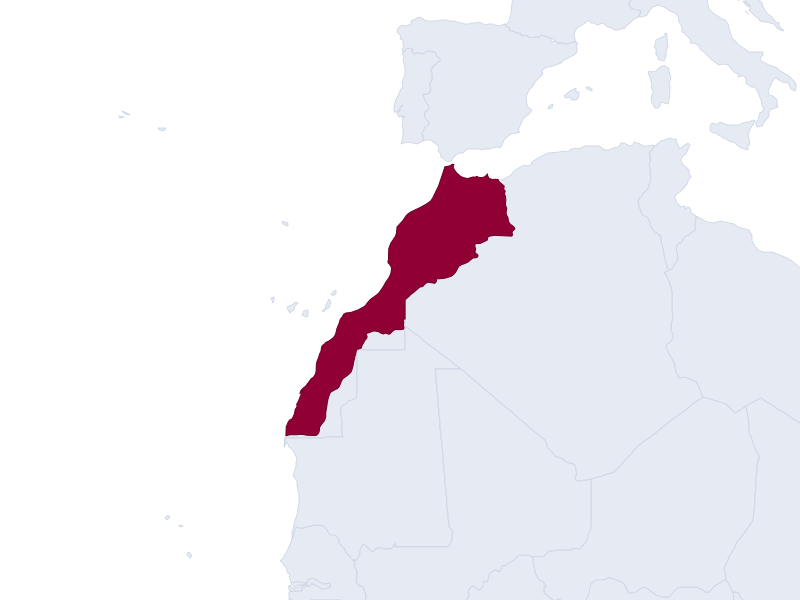
What a repatriation from Morocco costs
Morocco prices in the Europe, 2 to 4 hours band. The range alongside is bed to bed and all in, covering the ground ambulance at both ends, the UK receiving bed and clinical handover, crew, equipment and oxygen, the seat block or stretcher, handling, landing and permits, the escort return travel and case management. Nothing here is a flight price with extras to follow.
£3,000to£25,000
From a medical escort in an economy seat to an air ambulance, bed to bed and all in.
Figures as at August 2026, from a blend of actual UCS Assist cases and supplier ranges. Ranges are wide because cases are not alike. The full bed-to-bed cost breakdown prices each mode of transport, sets out what moves a case up its band and shows how to sense-check a quote.
Common questions
Where do insured British visitors actually get treated?
In the private clinic sector, which in Marrakech, Agadir and Casablanca is oriented towards foreign patients and tourists and is used to dealing with international insurers. The public system exists and will treat an emergency, but it is not where an insured visitor completes a pathway and it is not set up for that relationship. Establishing which facility the patient has been taken to, and what it can actually do, is the first call rather than the third.
How should the payment position be handled?
Early, in writing, and scoped. There is no reciprocal arrangement and no state fallback, so care is private from the first minute and the clinic has no relationship with the payer. A confirmed guarantee is what keeps the case moving. An open ended one, in a private market, commits the insurer to a pathway nobody has seen. This is the same discipline that applies in Mexico and Egypt, and it matters for the same reasons.
What makes a case in the Atlas mountains different?
The retrieval, which can take the better part of a day. Trekking routes in the High Atlas are reached by mountain track and often on foot or by mule for the final stretch, so the patient may be a long way from any vehicle, let alone an ambulance. Weather and daylight both constrain it. The flight home is three and a half hours and the journey to the aircraft can be considerably longer, which is exactly the inversion people fail to plan for.
Is the local care good enough to treat rather than repatriate?
For a good deal of the caseload, yes, particularly in the better private clinics in Casablanca and Marrakech. The honest question is the usual one about the ongoing pathway rather than the acute episode. What tilts this corridor slightly towards moving the patient, compared with Italy or Germany, is that the sector is short, so the cost and risk of bringing someone home is low, and the depth of specialist capability for a genuinely complex case is narrower.
Does the excursion caseload raise coverage questions?
Regularly. Quad biking, camel and horse riding, and off road excursions are sold hard to visitors and are frequently undertaken without helmets, licences or any thought about the policy. The clinical priority is unaffected by any of that. The coverage position needs establishing early and in writing rather than discovered at claim stage, and the member deserves a plain answer rather than a deferred one.
How quickly can a repatriation be arranged?
Once the patient is fit to travel, usually within 48 hours. The sector is short and there is reasonable scheduled capacity from Marrakech and Agadir in season. The constraints are obtaining a complete clinical record, which takes more chasing here than on a European corridor, and any ground leg from the mountains or the interior.
Other corridors
Managing a case in Morocco?
Our clinical and operational teams are available around the clock. If the case is live, call rather than email.