

Medical repatriation from the Dominican Republic
Punta Cana is a wall of all-inclusive resorts with a private clinic sector built around them. The care is transactional, the payment expectations are immediate, and the capability ceiling arrives sooner than the resort suggests.
8.5 to 9 hours direct from Punta Cana, with charter capacity concentrated in the winter season
No reciprocal arrangement. Insured visitors are treated in private clinics and billed privately, and payment or a firm guarantee is commonly expected before treatment progresses
What we typically see from Dominican Republic
- Severe gastrointestinal illness and dehydration, a high-volume category in an all-inclusive resort environment
- Cardiac events and strokes in older winter-season visitors
- Watersports, quad bike and excursion injury, including on catamaran and buggy trips sold at the resorts
- Road traffic trauma on the transfer routes between the airport and the resort strips
- Fractures and falls, including around pools and on resort steps
- Diving injury and decompression illness, at lower volume than the Pacific corridors but present
A resort strip with a clinic economy
Punta Cana is a concentration of large all-inclusive resorts, and the medical provision around it has developed to serve exactly that: private clinics oriented to visiting tourists, set up to treat quickly and to be paid quickly.
For the routine caseload that works. Straightforward injury and illness are handled competently and promptly, and the clinics are used to foreign patients.
Two things about the model need anticipating. The payment expectation arrives immediately, sometimes within the first hour. And the depth of capability is limited: for major trauma, complex cardiac intervention or intensive care sustained over any period, the answer lies in Santo Domingo or outside the country entirely.
Payment before progress
There is no reciprocal arrangement, no state fallback for an insured visitor, and no established relationship between a resort clinic and a British insurer.
The consequence is that a confirmed payer is often a precondition for treatment progressing rather than an administrative formality that follows it. A slow guarantee of payment does not delay paperwork here, it delays care.
The trap is the obvious response. Under time pressure, with a family on the phone and a clinic asking for confirmation, it is very easy to issue something open-ended simply to get things moving. That commits the insurer to a pathway nobody has assessed, in a private market where the provider decides how long the pathway runs. Fast and scoped is achievable, and it is the whole argument of who actually pays, and when.
Miami, and the cost of reaching for it
When local capability runs out, Miami is about two hours away with world-class hospitals. That is genuinely useful and it carries a specific warning.
A United States admission operates at a price level that dwarfs the Dominican account and escalates fast. The move needs its own scoped guarantee, issued deliberately, not an extension of the existing one waved through because the air ambulance is already on the ground.
Used for the right reason it is the correct clinical decision. Used as a reflex when the local facility is in fact managing the case, it converts a moderate claim into a very large one and buys nothing. The billing disciplines that then apply are set out on the United States corridor, and the same judgement appears on the Jamaica corridor.
The unglamorous majority
The largest single category here is not trauma. It is gastrointestinal illness severe enough to require admission and intravenous rehydration.
Large all-inclusive resorts, buffet dining, heat and alcohol reliably produce it in volume. Most is self-limiting. In older patients with cardiac or renal comorbidity, significant dehydration is not a minor event, and a proportion of these cases become genuine repatriations rather than a bad few days.
It is worth naming because it is the category insurers plan for least and see most.
Season and weather
Capacity to the UK is charter-driven and concentrated in the winter season. The hurricane season, roughly June to November, can remove airport capacity at short notice.
A summer case should be planned with an alternative routing held rather than a single departure, and with honest timescales given to the family rather than optimistic ones that then slip.
Before the patient moves
Fitness to travel is assessed against the patient’s actual trajectory by a UK clinician who is accountable for it, and revisited if the picture changes. The UK receiving bed is secured before departure, matched to the consultant and the pathway rather than to the arrival airport. The clinical record reaches the receiving team ahead of the patient, and ground transfers at both ends are arranged and briefed.
Every decision is recorded in Atlas as it is made. For the general picture see medical repatriation and patient transport, and for the neighbouring Caribbean corridor with stronger clinical links to the UK, medical repatriation from Barbados.
Where we stage from
The airport a case leaves from is a clinical decision as much as a logistical one, and it is set by where the patient is and what they can tolerate on the ground.
- Punta Cana (PUJ): the resort catchment and the great majority of cases and charter capacity
- Santo Domingo (SDQ): the capital, the deepest medical capability and the best year-round scheduled options
- Miami (MIA): roughly two hours away and the realistic escalation route where capability is exceeded
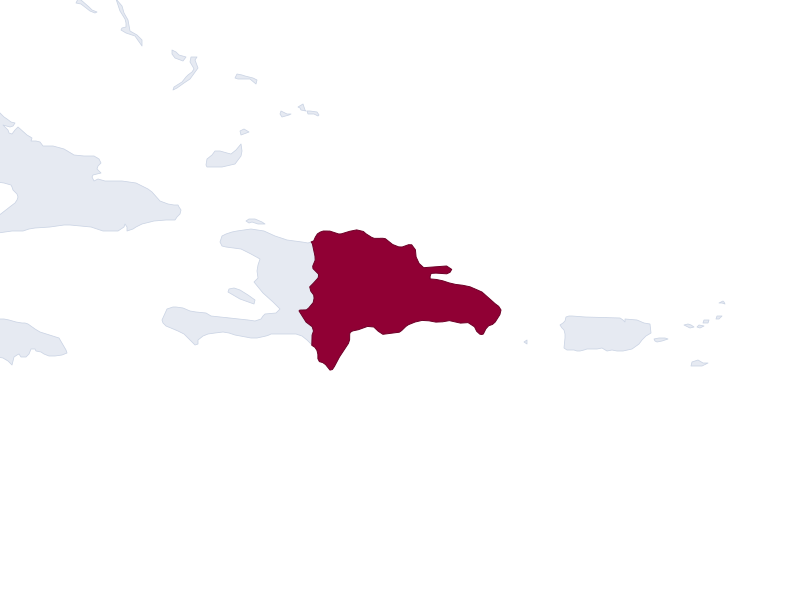
What a repatriation from Dominican Republic costs
Dominican Republic prices in the Medium haul, 5 to 8 hours band. The range alongside is bed to bed and all in, covering the ground ambulance at both ends, the UK receiving bed and clinical handover, crew, equipment and oxygen, the seat block or stretcher, handling, landing and permits, the escort return travel and case management. Nothing here is a flight price with extras to follow.
£5,000to£30,000
From a medical escort in an economy seat to an air ambulance, bed to bed and all in.
At 8.5 to 9 hours this corridor sits at the very top of the band, and charter capacity varies sharply by season.
Figures as at August 2026, from a blend of actual UCS Assist cases and supplier ranges. Ranges are wide because cases are not alike. The full bed-to-bed cost breakdown prices each mode of transport, sets out what moves a case up its band and shows how to sense-check a quote.
Common questions
What is the private clinic sector like?
It is built around the resort strips and it is transactional in a way that surprises people. Clinics are set up to treat visiting tourists quickly and to be paid quickly, and the standard for straightforward presentations is generally adequate. What is thinner is depth: for major trauma, complex cardiac intervention or sustained intensive care, capability is limited outside Santo Domingo, and recognising that early is the whole skill.
Why does the payment position come up so fast?
Because the model expects it. Clinics serving the resorts commonly want payment or a firm guarantee before treatment progresses, sometimes within the first hour, and a patient without a confirmed payer may find the case simply does not move. That is rational behaviour for a facility with no relationship to the payer. It also means a slow guarantee of payment delays care rather than paperwork, and it means an unscoped one, issued in a hurry to get things moving, commits the insurer to a pathway nobody has looked at.
When should a patient be moved to Miami?
When they need capability the country cannot provide, and not as a reflex. Miami is roughly two hours away with capability equivalent to anywhere in the world, which makes it a genuinely valuable option. It also operates at a price level that dwarfs the Dominican account and escalates quickly. Any move there needs its own scoped guarantee of payment rather than a hurried extension, and the same disciplines that apply on the United States corridor apply from the moment the patient lands.
Why is gastrointestinal illness such a large category?
Because of the environment rather than anything sinister. Large all-inclusive resorts, buffet dining, heat, alcohol and thousands of guests together produce a high volume of gastrointestinal illness, most of it self-limiting and some of it severe enough to require admission and intravenous rehydration. In older patients with cardiac or renal comorbidity, dehydration is not a minor problem, and these cases occasionally become repatriations.
Does the season affect transport?
Yes. Capacity to the UK is charter-driven and concentrated in the winter season, and the hurricane season between June and November can remove airport capacity at short notice. A summer case is worth planning with an alternative routing held rather than a single scheduled departure.
How quickly can a repatriation be arranged?
In season, usually two to three days once the patient is fit to travel. Out of season, longer, and often via Santo Domingo or a US hub. Obtaining a complete clinical record from a resort clinic takes chasing and should be started on day one.
Other corridors
Managing a case in Dominican Republic?
Our clinical and operational teams are available around the clock. If the case is live, call rather than email.