

Medical repatriation from the United States
The USA is the only corridor where the cost of the treatment routinely exceeds the cost of the aircraft. Managing the bill is not a side task here. It is the case.
7 to 8 hours from the East Coast, 10 to 11 from the West Coast
No reciprocal arrangement whatsoever. Charges are unregulated and among the highest in the world
What we typically see from United States
- Cardiac events and strokes in older visitors, frequently presenting to a facility with no cover verification
- Road traffic trauma, including on the long-distance driving routes and in rental vehicles
- Ski and snowboard injuries in the Colorado, Utah and Vermont resort corridors
- Orthopaedic and neurological trauma from theme park, watersports and adventure activity
- Acute presentations in visitors staying with family, often outside the major metropolitan trauma networks
- Premature births and neonatal admissions, which carry the highest daily rates of any category
The only corridor where the bill outruns the aircraft
On most corridors, transport is the large number and treatment is the manageable one. In the United States that is reversed, and it changes how the case should be run from the first hour.
A UK visitor admitted to a US hospital is billed against a chargemaster rate: the list price, which no domestic insurer pays and which bears little relation to cost. Days in intensive care accumulate figures that would fund a transatlantic air ambulance several times over. A neonatal admission can outrun almost any transport option within a fortnight.
That does not mean move everybody immediately. It means the cost work and the clinical work have to run in parallel from day one, rather than the bill being handed to somebody afterwards.
Cost containment as the primary workstream
American billing is not challenged effectively by arguing about the total. It is challenged line by line, against the clinical record.
The recurring patterns are consistent and substantial:
- Unbundled procedures, billed as separate line items where a single code applies.
- Duplicated charges, particularly imaging repeated on transfer between facilities.
- Upcoded acuity, where the level of care billed exceeds the level delivered.
- Consumables and pharmacy billed at multiples of any defensible market rate.
- Intensive care beds retained past the point of clinical need, because nobody is pressing for step-down.
- Investigation of incidental findings during an episode of care for something unrelated.
Identifying these requires reading the clinical record alongside the invoice, which requires a clinician. That is the argument in medical cost containment applied to the market where it pays for itself fastest, and at more length in cost containment beyond network discounts.
Repatriation as a legitimate cost decision, with a clinical floor
This is the one corridor where “we are moving the patient partly because of what it costs to keep them here” is an honest and defensible position rather than an uncomfortable one.
It still has a clinical floor beneath it, and the floor does not move:
- The patient must be genuinely fit to travel, assessed against their trajectory rather than the invoice.
- There must be an appropriate UK bed matched to the pathway, secured before departure.
- The transfer itself must be clinically safe, with the right escort, equipment and mode.
Where those hold, moving early is better for the insurer and frequently better for the patient, who gets home to their family and their own care system sooner. Where they do not hold, moving early is a bad clinical decision that eventually costs more than it saved.
Guarantees of payment, scoped
US hospitals have international patient departments and are entirely accustomed to guarantees of payment from foreign insurers. What they are not accustomed to is one issued with defined scope.
An open-ended GOP in this market is a blank cheque. Issued with scope, meaning this admission, this indication and this pathway, with any extension requiring a fresh decision, it establishes what is authorised before treatment proceeds instead of after it concludes. On a corridor with these tariffs, that single discipline is worth more than any subsequent negotiation.
The transport picture, coast by coast
East Coast, seven to eight hours, is comfortably within commercial stretcher range with good scheduled availability from JFK, Newark, Boston, Miami and Orlando. For a stable patient this is usually both the clinically appropriate and the far cheaper answer.
West Coast, ten to eleven hours, is a different clinical problem. It demands the same care as the Thai corridor: oxygen quantity, thromboembolic risk, infusion management over a long duty period, escort fatigue. A patient fit for a Boston sector may not yet be fit for a Los Angeles one.
Dedicated air ambulance across the Atlantic is expensive and frequently requires a technical stop for range. It is reserved for high-acuity cases. Where the alternative is another fortnight in a US intensive care unit, the arithmetic can favour it decisively, and on this corridor that calculation is worth actually doing rather than assuming.
Inland cases stage first
Not every US case starts near a gateway airport. A patient in rural Montana or inland Texas needs a domestic leg to a facility and an airport with capability before the transatlantic question arises. We coordinate that as clinical transport rather than leaving it to be arranged locally.
Before the patient moves
The UK receiving bed is secured before departure and matched to the specialty required. The clinical record, imaging and results reach the receiving team ahead of the patient. Ground transfers at both ends are arranged and briefed, and the handover is a documented clinical exchange.
Every decision, clinical and commercial, is recorded in Atlas as it is made, with the clinician who made it, which on this corridor also means every cost challenge is traceable to a specific clinical rationale. For the full picture see medical repatriation and patient transport.
Where we stage from
The airport a case leaves from is a clinical decision as much as a logistical one, and it is set by where the patient is and what they can tolerate on the ground.
- New York (JFK, EWR) and Boston (BOS): shortest sector, best scheduled stretcher availability
- Miami (MIA) and Orlando (MCO): the Florida visitor market, highest UK case volume in the country
- Los Angeles (LAX) and San Francisco (SFO): west coast, where sector length changes the clinical calculus
- Chicago (ORD) and Dallas (DFW): realistic staging points for inland cases
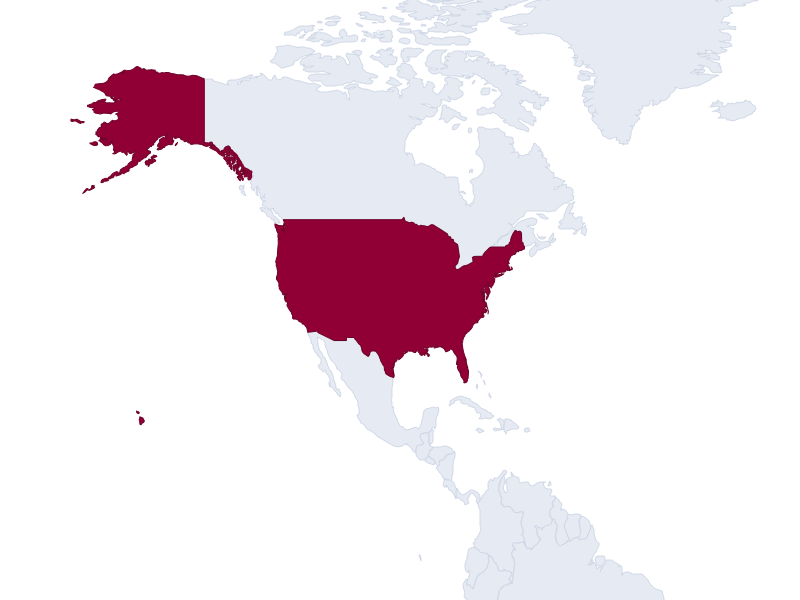
What a repatriation from United States costs
United States prices in the Medium haul, 5 to 8 hours band. The range alongside is bed to bed and all in, covering the ground ambulance at both ends, the UK receiving bed and clinical handover, crew, equipment and oxygen, the seat block or stretcher, handling, landing and permits, the escort return travel and case management. Nothing here is a flight price with extras to follow.
£5,000to£30,000
From a medical escort in an economy seat to an air ambulance, bed to bed and all in.
The East Coast prices in this band. The West Coast sits at 10 to 11 hours and prices as long haul.
Figures as at August 2026, from a blend of actual UCS Assist cases and supplier ranges. Ranges are wide because cases are not alike. The full bed-to-bed cost breakdown prices each mode of transport, sets out what moves a case up its band and shows how to sense-check a quote.
Common questions
Why are US medical bills so high, and can anything be done about them?
US hospitals bill against a chargemaster rate that bears little relation to what any insurer actually pays, and an uninsured or foreign patient is billed at that rate by default. A great deal can be done, but not by disputing the total. It is done by reviewing the itemised bill against what was clinically delivered, removing unbundled, duplicated and upcoded lines, and negotiating from a clinically reasoned position. A hospital finance office presented with a referenced clinical argument settles very differently to one presented with a blanket percentage demand.
Should we repatriate to reduce the cost?
Frequently yes, and this is the one corridor where cost is a legitimate and clinically defensible driver rather than an uncomfortable one. Daily rates in a US intensive care unit can exceed the entire cost of an air ambulance transfer within days. But it has to remain a clinical decision: the patient must be fit to travel and there must be an appropriate UK bed to travel to. Moving a patient who is not ready is a bad outcome that also, eventually, costs more.
How quickly should we get involved?
Immediately, and earlier than on any other corridor. Every day of unmanaged US admission accrues cost at a rate that dwarfs the transfer. Early involvement means the treatment plan is reviewed clinically while it is still being made, a guarantee of payment is issued with defined scope rather than open-ended, and the discharge and transfer are being driven from day one instead of week two.
Will the hospital deal with us directly?
Yes, and they are used to it. US hospitals have international patient departments and established processes for guarantees of payment from foreign insurers. What they are not used to is a clinician challenging the necessity of a treatment pathway, which is precisely why doing so is effective.
Air ambulance or commercial stretcher across the Atlantic?
The East Coast at seven to eight hours is comfortably within commercial stretcher range, and carriers on those routes handle stretchers routinely. The West Coast at ten to eleven hours is a different clinical problem, closer to the Thai corridor in its demands on oxygen, immobility and escort duty. Dedicated air ambulance across the Atlantic is expensive and often requires a technical stop, so it is reserved for genuinely high-acuity cases. Where the alternative is another fortnight in a US intensive care unit, though, the arithmetic can favour it decisively.
What about a neonatal or paediatric case?
They are the highest-cost category in the highest-cost market, and they need specialist transport with the appropriate incubator and clinical team. They also need the receiving UK unit agreed in advance, since neonatal capacity is not something to start looking for on arrival. Call early.
Other corridors
Managing a case in United States?
Our clinical and operational teams are available around the clock. If the case is live, call rather than email.