

Medical repatriation from Vietnam
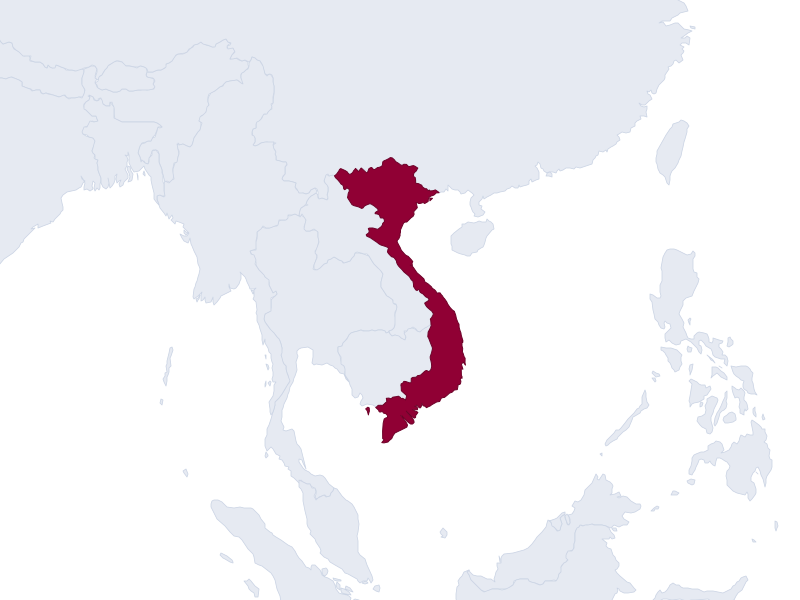
Vietnam is fifteen hundred kilometres end to end and the caseload is spread along all of it. The question is rarely what the patient needs. It is which of the two cities that can provide it they are closest to.
13 to 14 hours from Hanoi or Ho Chi Minh City, usually with a connection
No reciprocal arrangement. Insured visitors are managed in international clinics and private hospitals, billed privately, with payment confirmation expected up front
What we typically see from Vietnam
- Motorbike and scooter trauma, the dominant category by a wide margin, frequently with head injury
- Road traffic injury as a pedestrian or passenger, in a traffic environment visitors consistently misjudge
- Diving injury and decompression illness around Nha Trang, Phu Quoc and Con Dao
- Trekking and adventure injury in the north around Sapa and Ha Giang, where retrieval is slow
- Severe gastrointestinal and febrile illness including dengue, requiring admission and rehydration
- Cardiac events in older visitors on touring itineraries, often between the two cities with capability
Fifteen hundred kilometres of coastline, two cities of capability
Vietnam’s shape is the first thing to understand about working here. It is very long, the classic itinerary runs its whole length, and genuine medical capability is concentrated in Hanoi and Ho Chi Minh City at either end.
That means an internal transfer is usually a flight, not a drive, and it is a distinct event with its own cost, its own clinical handover and its own scheduling. A patient injured in Hoi An is a domestic flight from the nearest hospital that can properly manage them. A patient in the far north around Sapa or Ha Giang faces a long mountain road journey before even that becomes possible.
Reading a Vietnamese case as a single flight home is the standard planning error. There are almost always two journeys, and the first one determines the timeline.
Motorbikes
The dominant category, and it is not close.
Visitors hire motorbikes in Vietnam who have never ridden one at home, ride them in traffic that follows conventions they have not learned, frequently without a licence that covers them, and with helmets of variable quality. The result is a steady stream of head injuries, facial trauma, limb fractures and deep abrasions that infect quickly in the heat and humidity.
Two consequences follow for an insurer. Head injury dominates the transport decision even though it is a minority of the volume, because the gap between neurologically well on a ward and fit for a fourteen hour multi-sector journey is genuine and is measured in days rather than hours. And a proportion of these cases raise licensing and helmet questions that are better established early, in writing, than discovered at claim stage. That conversation should never delay the clinical response, and it should never be left until the invoice.
Clinics, hospitals and what each is for
The international clinics in the main cities do a specific job well: competent assessment, stabilisation and straightforward care, in English, with staff used to foreign patients and international insurers. For most visitor presentations they are exactly the right first destination.
They are not tertiary hospitals, and treating them as though they were is unfair to them and dangerous for the patient. For major neurotrauma, complex surgery, or intensive care sustained over any period, the honest options are one of the larger private hospitals in Hanoi or Ho Chi Minh City, or a regional move.
Bangkok and Singapore are both a short flight away and both have capability equivalent to a good UK teaching hospital. That move is right when the patient needs something Vietnam cannot provide, or when they are far from being fit for the journey home and local stabilisation is not realistic. It is wrong when it is simply a reflex. The judgement is set out from the other side on the Singapore corridor.
Paying for it
There is no reciprocal arrangement and no state alternative for an insured visitor. Care is private from the first minute, and facilities serving foreign patients commonly expect a confirmed payer, sometimes a deposit, before treatment progresses.
That is rational behaviour from a facility with no relationship to the payer, and it means a slow guarantee of payment delays care rather than paperwork. Fast and scoped is the answer, and where a regional evacuation is in prospect the guarantee has to anticipate a second facility in a second country explicitly.
Before the patient moves
Fitness to travel is assessed against the patient’s actual trajectory by a UK clinician who is accountable for it, and revisited if the picture changes. The UK receiving bed is secured before departure, matched to the consultant and the pathway rather than to the arrival airport. The clinical record reaches the receiving team ahead of the patient, and ground transfers at both ends are arranged and briefed.
Every decision is recorded in Atlas as it is made. For the general picture see medical repatriation and patient transport, and for the neighbouring corridor with the same scooter problem and a deeper private hospital market, medical repatriation from Thailand.
Where we stage from
The airport a case leaves from is a clinical decision as much as a logistical one, and it is set by where the patient is and what they can tolerate on the ground.
- Ho Chi Minh City (SGN): the widest capability and the best international connections
- Hanoi (HAN): the north, with good private and international hospital provision
- Da Nang (DAD): the centre, useful for Hoi An and Hue, though complex cases usually move on
- Bangkok (BKK) and Singapore (SIN): the regional stabilisation options where local capability is exceeded
What a repatriation from Vietnam costs
Vietnam prices in the Long haul, 9 hours plus band. The range alongside is bed to bed and all in, covering the ground ambulance at both ends, the UK receiving bed and clinical handover, crew, equipment and oxygen, the seat block or stretcher, handling, landing and permits, the escort return travel and case management. Nothing here is a flight price with extras to follow.
£8,000to£75,000
From a medical escort in an economy seat to an air ambulance, bed to bed and all in.
Figures as at August 2026, from a blend of actual UCS Assist cases and supplier ranges. Ranges are wide because cases are not alike. The full bed-to-bed cost breakdown prices each mode of transport, sets out what moves a case up its band and shows how to sense-check a quote.
Common questions
Why do motorbikes dominate the caseload?
Because visitors hire them constantly, in a traffic environment unlike anything they have ridden in, often without a licence that covers them and with helmets of variable quality. The injuries follow the physics: head injury, facial trauma, limb fractures and the deep abrasions that infect quickly in the climate. Head injury is the one that governs the transport decision, because the interval between being neurologically well on a ward and being fit for a fourteen hour journey is a real clinical distance.
What are the international clinics actually able to do?
They are good at what they are for. The international clinics in Hanoi, Ho Chi Minh City and Da Nang provide competent assessment, stabilisation and straightforward care in English, and they are the right first destination for most visitor presentations. They are not tertiary hospitals. For major neurotrauma, complex surgery or intensive care over any length of time, the realistic answer is either one of the larger private hospitals in the two main cities or a regional move to Bangkok or Singapore.
Is a regional evacuation usually necessary?
Not usually, but often enough that it should be considered explicitly rather than by default in either direction. It is right when the patient needs capability the country cannot provide, or when they are a long way from being fit for a fourteen hour sector and getting them there locally is not realistic. Bangkok and Singapore are both a short flight away. Where the patient is stable and the pathway is straightforward, a direct repatriation is better and cheaper.
How long do internal transfers take?
Vietnam is around fifteen hundred kilometres long, so an internal transfer between regions is a flight rather than a drive, and it needs planning as a separate event with its own handover. A patient in the far north around Ha Giang or Sapa may face a long road journey to Hanoi before any flight at all, on mountain roads where weather matters.
How should the payment position be handled?
Early, in writing, and scoped. Care is private throughout with no state fallback, and facilities serving foreign patients commonly expect a confirmed payer, sometimes a deposit, before treatment progresses. A slow guarantee here does not just delay administration, it delays care, and where a regional move to Bangkok or Singapore is in prospect the guarantee needs to anticipate a second facility in a second country.
How quickly can a repatriation be arranged?
Once the patient is in Hanoi or Ho Chi Minh City and fit to travel, typically two to four days. Most routings involve a connection, which adds a transit to plan for rather than a gap in the plan.
Other corridors
Managing a case in Vietnam?
Our clinical and operational teams are available around the clock. If the case is live, call rather than email.