

Medical repatriation from Pakistan
This is a family corridor, not a holiday one. The patient is usually a British national three weeks into a two-month visit, and the clinical problem is rarely an accident.
7.5 hours from Islamabad, 8 from Lahore, 8.5 to 9 from Karachi, with good direct scheduled capacity
No reciprocal healthcare arrangement of any kind. Care is paid for at the point of delivery, and the private hospitals that matter expect a guarantee of payment before they admit
What we typically see from Pakistan
- Deterioration of chronic disease during long visits, particularly cardiac, renal and diabetic, in patients weeks away from the UK service that manages them
- Stroke and myocardial infarction in older visitors, often presenting late because symptoms were attributed to travel or heat
- Road trauma, a genuinely high-risk category here and disproportionately involving passengers rather than drivers
- Enteric fever, hepatitis and other infectious disease acquired on extended stays outside the major cities
- Falls and fractures in elderly relatives staying in homes not adapted for reduced mobility
- Respiratory deterioration through the Lahore winter smog season, which is severe and reliably underestimated
A different kind of case
Most corridors are shaped by how people holiday. This one is shaped by how people visit family.
A UK traveller to Spain is away for ten days and comes home with a fracture. A UK traveller to Pakistan is away for six weeks, is frequently over sixty, and comes home because a condition they were already managing has come apart at distance from the service that manages it.
That single fact drives everything else. The typical case is medical rather than traumatic, complex rather than clean, and often involves a patient whose UK clinical history matters enormously and sits in a GP record nobody in Lahore can see.
Three cities, and then a cliff
Pakistan has private hospitals in Karachi, Lahore and Islamabad that will manage a ventilated patient properly. That is worth saying plainly, because assumptions usually run the other way.
It is equally true that capability drops off very steeply outside those cities. A patient who has a cardiac event while staying with family in a smaller district town is not near any of it. The first move is frequently not to the UK at all but to one of the three, and getting that leg right matters more than any decision that follows it.
Payment decides the hospital
With no reciprocal arrangement, private hospitals here operate on a straightforward commercial basis and want to know who is paying before a patient is admitted.
That makes a guarantee of payment an admission tool as much as a financial one. Issued early with defined scope, it opens the right hospital. Left until the family has already been directed somewhere, it is a document chasing a decision that was made badly.
Where there is no insurer, and here there often is not, the same principle holds with the family in the payer’s seat. They deserve real numbers early rather than escalating surprises.
The medication problem
A patient six weeks into a visit has usually brought four weeks of medication. What they are given locally may be the same drug under a different name, a different formulation, or a substitute.
By the time repatriation is planned, reconstructing what the patient has actually taken, and when, is real clinical work rather than a formality. It matters for fitness to fly, for the escort handover, and for the receiving team who would otherwise inherit a gap in the record.
The sector home
The flight is the easy part. Islamabad is seven and a half hours, Lahore eight, Karachi eight and a half to nine, all with direct scheduled capacity and carriers that accept a stretcher on reasonable notice.
A stable patient goes home on a commercial aircraft with the right escort and oxygen provision. An air ambulance earns its cost when the patient cannot tolerate a scheduled cabin, or when the ground time either side of a commercial sector is itself the clinical risk.
What we do differently here
We plan this corridor backwards from the UK receiving bed, because on a complex medical case that bed is harder to secure than the seat. A patient with deteriorating renal function coming home to a district general needs the receiving team to have accepted them, not merely to have been told they are coming.
And we treat the family as part of the case rather than an audience for it. On a corridor where relatives are frequently the payer, the interpreter and the only source of the patient’s history, that is not a courtesy. It is how the case gets managed properly.
Where we stage from
The airport a case leaves from is a clinical decision as much as a logistical one, and it is set by where the patient is and what they can tolerate on the ground.
- Islamabad (ISB): the shortest sector to the UK, good handling, and the usual staging point for the north
- Lahore (LHE): strong scheduled capacity and some of the best private tertiary care in the country
- Karachi (KHI): the longest sector, and where the strongest critical care capability sits
- Peshawar (PEW) and Multan (MUX): regional, and almost always a domestic leg before anything international
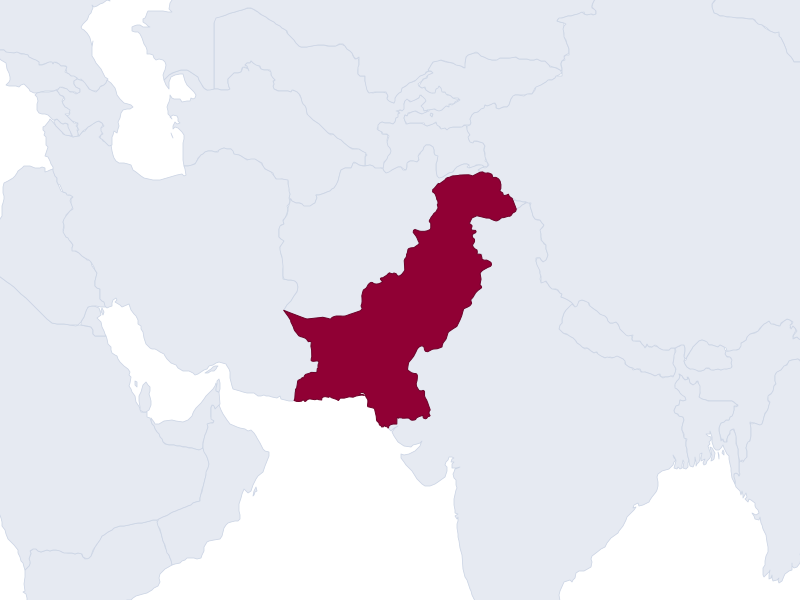
What a repatriation from Pakistan costs
Pakistan prices in the Medium haul, 5 to 8 hours band. The range alongside is bed to bed and all in, covering the ground ambulance at both ends, the UK receiving bed and clinical handover, crew, equipment and oxygen, the seat block or stretcher, handling, landing and permits, the escort return travel and case management. Nothing here is a flight price with extras to follow.
£5,000to£30,000
From a medical escort in an economy seat to an air ambulance, bed to bed and all in.
Islamabad and Lahore sit comfortably in this band. Karachi runs to 8.5 or 9 hours, and a stretcher case from there can price as long haul.
Figures as at August 2026, from a blend of actual UCS Assist cases and supplier ranges. Ranges are wide because cases are not alike. The full bed-to-bed cost breakdown prices each mode of transport, sets out what moves a case up its band and shows how to sense-check a quote.
Common questions
Why are so many cases on this corridor not accidents?
Because the travel pattern is different. Most UK visitors to Pakistan are visiting family, they stay for weeks rather than days, and a large proportion are older and already managing a long-term condition. Six weeks away from a UK cardiology or renal service, in a hot climate, often without a full medication supply, produces deterioration rather than trauma. Planning this corridor means expecting a complex medical patient, not a fracture.
How good are the hospitals?
The best private hospitals in Karachi, Lahore and Islamabad are genuinely excellent and entirely capable of managing a critical patient to a standard any UK intensivist would recognise. Outside those three cities the picture changes sharply, and a patient in a smaller city or a rural district may be somewhere with no intensive care and no interventional capability. The first question here is usually whether the patient is in the right hospital, not whether they should fly.
Does a GHIC cover anything in Pakistan?
No. There is no reciprocal arrangement between the UK and Pakistan, so every element of care is chargeable, and the hospitals that matter want payment arranged before admission rather than after. A guarantee of payment issued early with defined scope is worth more on this corridor than almost anywhere, because it determines which hospital will take the patient at all.
What about patients travelling without insurance?
It is more common here than on a leisure corridor, and it changes the conversation rather than ending it. Families frequently fund care and repatriation themselves, sometimes across several relatives, and they are making financial decisions under stress with no idea what anything should cost. Honest figures early, and a clear statement of what a bed-to-bed price does and does not include, is the most useful thing anybody can give them.
Is a commercial stretcher realistic here?
Yes, and it is usually the right answer. Direct capacity from Islamabad, Lahore and Karachi is good, several carriers will accept a stretcher with notice, and the sector is short enough that a stable patient does not need a jet. An air ambulance is for the patient who cannot tolerate a scheduled cabin or the ground time either side of it, not for the patient whose family is anxious.
How long does the documentation take?
Longer than the clinical decision, routinely. Records are often paper, a discharge summary can take a day to produce in a form an airline medical desk will accept, and where a patient has been treated across two hospitals the picture has to be assembled rather than requested. Start it when repatriation becomes likely, not when the patient is declared fit to fly.
Other corridors
Managing a case in Pakistan?
Our clinical and operational teams are available around the clock. If the case is live, call rather than email.